
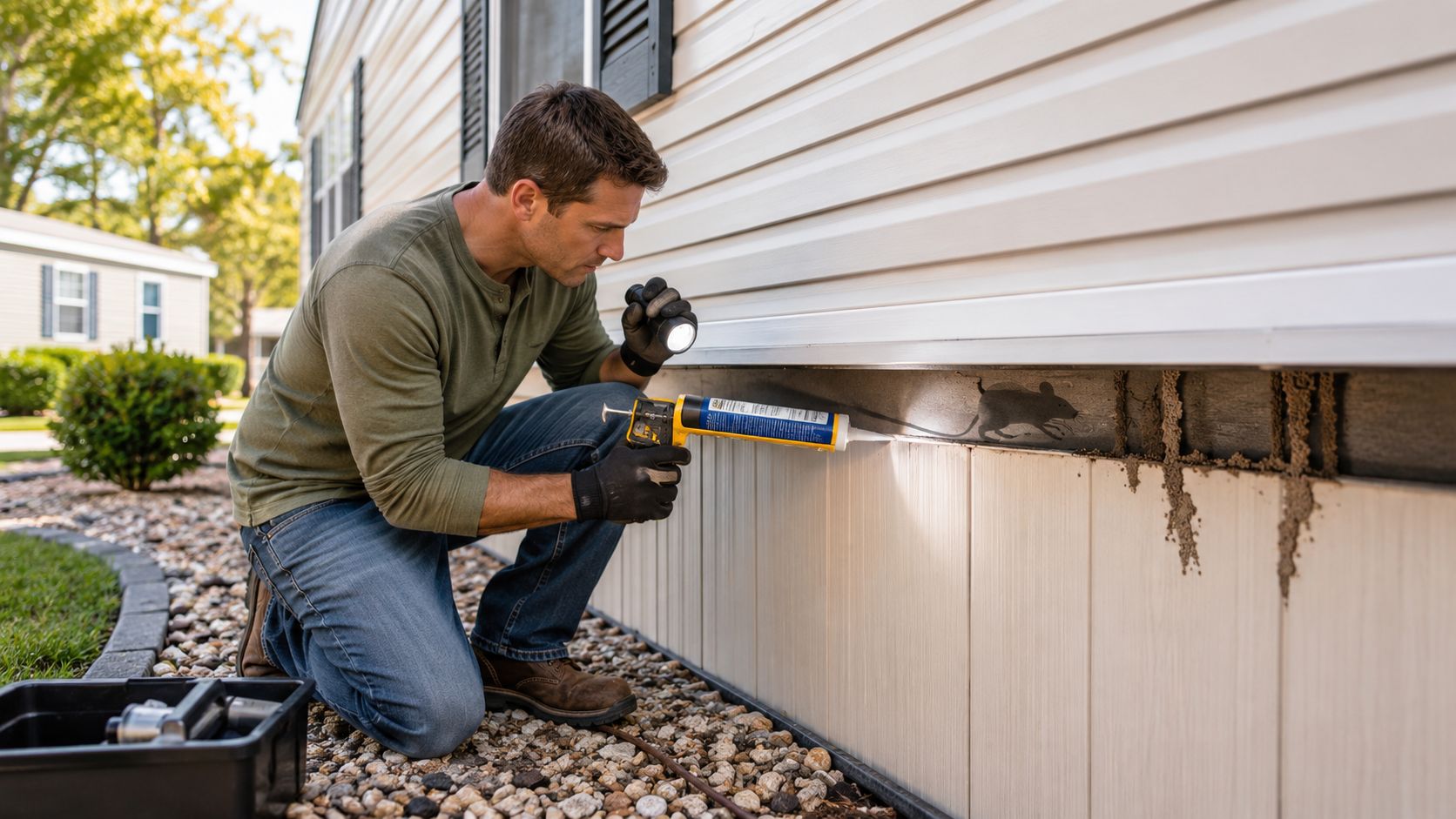
The soft spot under the kitchen sink always seems small until you're under the home with a flashlight and the belly board is sagging around it. That's usually when the story gets clearer, a little moisture, a little food, a little cover, then pests move in where the floor, skirting, and plumbing all meet.
Mobile homes don't give you the same warning signs as site-built houses. They telegraph trouble through the underside first. You notice a creak near the dishwasher, a warm tile, a smell under the sink after a humid week, or scratching that starts at midnight and fades when you get up.
The first thing I look at is the structure, not the bug. Rodents, roaches, and termites all use the underside differently, but they all take advantage of the same weak points, skirting gaps, plumbing penetrations, damp belly wrap, and hidden cellulose that stays wet too long. HUD's manufactured-housing reference materials treat pest control and termite zones as part of formal guidance, which matches what you see in the field, this isn't a side issue, it's core maintenance (HUD manufactured housing reference guide).
What Mobile Home Pest Problems Usually Look Like
A homeowner will often call about a noise before they ever see a pest. It starts with a soft tile near the dishwasher, or a baseboard that gives when you step close to the bathroom wall. Then comes the midnight scratching, usually near plumbing, because that's where the first break in the system lives.
The home usually speaks before the pest does
Rodents leave clues along the subfloor edge, then chew where pipes pass through. Roaches like warm, enclosed spaces, so the smell under the sink gets faintly stale after a warm spell, and the activity stays close to moisture. Termites are different, they work from the ground up and leave mud tubes on skirting or other hidden surfaces, which is why the crawl space matters so much.
That pattern isn't random. In manufactured housing, the floor system and the belly board often tell the truth before the walls do.
Practical rule: if the sound, smell, or stain is strongest near the plumbing wall, start there first. Chasing the living room usually wastes time.
The U.S. public health review of manufactured structures found that the 2007 American Housing Survey recorded 70,000 occupied manufactured housing units, or 1.0%, with rat signs in the previous three months, and 692,000 units, or 10.0%, with mouse signs. The same review also treats pests and pesticides as core health-and-safety topics for this housing type, which fits what most techs see under skirting every week (A major U.S. public health review on manufactured structures).
The practical part is simple. If you find droppings, gnawing, or a new smell, don't treat the symptom in the living area and call it done. Read the underside, read the skirting, then decide whether you're sealing, treating, or both.
Seal the Envelope Before You Treat the Pests
A lot of money gets burned on bait before the gaps are closed. That's the wrong order. If the home is still open at utilities, vents, skirting seams, or floor penetrations, you're feeding the next mouse, roach, or ant that finds the opening.
Start at the outside edge
Walk the perimeter with a flashlight. Check pipe penetrations under sinks, the dryer vent, the water heater closet door sweep, the marriage line between sections, and any tear in the belly board that's visible from the crawl space. Look at the skirting bottom too, because that's the main closure plane on most homes.
The best seal is the one pests can't work loose. Foam alone is a weak answer under skirting, since rodents chew it. Use sealant, metal mesh, weatherstripping, and solid repair where the damage is bigger than a cosmetic gap.
A gap that looks tiny from standing height can be a highway underneath.
For closure work, I think in terms of the object, not the pest theory. If the opening is at a vent, use durable mesh and keep the airflow that's meant to stay open. If it's at a pipe or cable run, seal around the penetration and inspect the inside wall after the outside patch is done. If the skirting panel is broken, repair the panel, then close the bottom edge so the opening doesn't reopen the first time the ground shifts.
| Pest | Smallest opening they pass through | Where to inspect first |
|---|---|---|
| Mouse | About the size of a pencil opening | Pipe penetrations, skirting seams |
| Rat | About the size of a quarter opening | Damaged skirting, utility entries |
| Roach | A crack about the thickness of a credit card | Sink bases, appliance gaps, vent edges |
Treating before sealing usually means the bait or trap catches a few, then more move in. Closing the structure first changes the math. It also tells you where the remaining activity is coming from, which is half the job.
Rodents, Roaches, and Termites in Mobile Homes
Rodents, roaches, and termites all like manufactured homes for different reasons. Rodents want dark entry routes and nesting material. Roaches want moisture and food residue. Termites want wet cellulose and hidden wood contact.
Rodents travel the hard edges
Mice and rats usually come in through skirting openings and plumbing penetrations. They feed on pet food, crumbs, and wiring insulation. Snap traps work best when they sit flush to the wall along a travel run, not in the middle of the room where the animal doesn't feel protected.
The trap is not the first fix. The seal is.
Roaches live close to water
German roaches don't wander far from moisture. They show up in cabinets, under sinks, near refrigerator compressors, and around water-heater zones. Gel bait belongs inside the harborages, not on open baseboards, and sprayed residues can interfere with the bait if you put them in the same place.
Termites follow damp wood
Subterranean termites enter from the ground against skirting or through wet wood near a bathroom or utility area. They feed on floor joists and belly-board materials, and they keep working if the moisture source stays in place. That's why a proper termite response is layered, moisture control, exclusion, and the right treatment at the active zone.
A field study of integrated pest management in rural manufactured homes documented an 86% decline in German cockroach population levels over a 27-month study period after education and insecticide baiting were introduced. It also found that 34% of all trap catches occurred around refrigerators, and that pheromone sticky traps captured 73% of the cockroaches caught, which is a good reminder that placement matters as much as product choice (CDC field study).
| Pest | Entry point | Food or moisture driver | First treatment that matches the biology |
|---|---|---|---|
| Rodents | Skirting, pipe openings | Stored food, insulation, nesting material | Seal entry points, then snap trap along runs |
| Roaches | Appliances, bags, plumbing gaps | Moisture, residue, harborage | Place gel bait in hidden travel areas |
| Termites | Soil contact, wet wood | Moist cellulose, hidden moisture | Treat active wood or soil zone, then fix moisture |
A common failure is mixing these jobs together. Baiting roaches while a mouse is still entering means the roach issue never resolves cleanly, because the structure is still open and the food chain around the home keeps changing.
The Underbelly and Crawl Space Decision
The underside of a mobile home is one system, not three separate problems. Moisture, airflow, insulation, and pest access all interact. If you change one part without thinking about the others, you can make the place worse.
Vented, sealed, or conditioned
Some homes are fully vented with a bare ground cover. Some are sealed and brought closer to conditioned air with a register or dehumidifier. Some land in the middle, with a partial seal that tries to do both jobs at once.
That middle ground is where a lot of problems linger. Too open, and pests get in with damp air and easier entry. Too sealed, and trapped moisture can sit where wood and insulation meet, which feeds mold, rot, and termite pressure. Independent technical discussion on crawl-space venting makes the same point: the core issue is the interaction between vents, vapor barriers, insulation, drainage, and humidity, not just whether a vent exists (crawl-space vent guidance).
If you don't want to crawl, use your senses from the edge. Look for daylight at the skirting seams. Press the belly board for soft spots. Smell for musty air near access doors. Check for dark staining around plumbing penetrations.
The Southeast and Gulf coast are tough on vented undersides with bare soil, because the moisture load stays high and the pest pressure never really lets up. In a drier climate, the same setup may be less punishing, but hidden leaks still create the same trouble. Venting is not a magic fix. Sealing is not either.
Practical rule: if the home smells damp under the edge, treat moisture before you treat pests again.
A vapor barrier makes sense when bare ground is contributing moisture, but foam closures at pipe penetrations have a limit. They can stop air movement. They can't fix rot, bad drainage, or a belly wrap that's already wet. Insulation under the belly board without air sealing usually creates a pocket that holds moisture, and that pocket becomes a pest problem fast.
For community operators who need a simple way to point residents toward service options, this community resources page is the right place to start.
Working Through an Active Infestation
The roach job is the one that teaches the sequence best, because it exposes sloppy work immediately. I've pulled drawers, shined a light behind the refrigerator, and found that the activity sits in the warm corner nobody wanted to move.
Work the harborages, not the open room
Start by checking the lower kitchen drawers, behind the refrigerator, under the sink, and around the dishwasher motor. Vacuum the visible roaches and egg cases first. Then place gel bait along the wall-floor junction, under the sink near the trap, and inside any junction-box gap where they travel.
Do not spray over the bait. That kills the setup. If you need a residual treatment, separate it in time and place so the roaches survive long enough to carry bait back into the harborages.
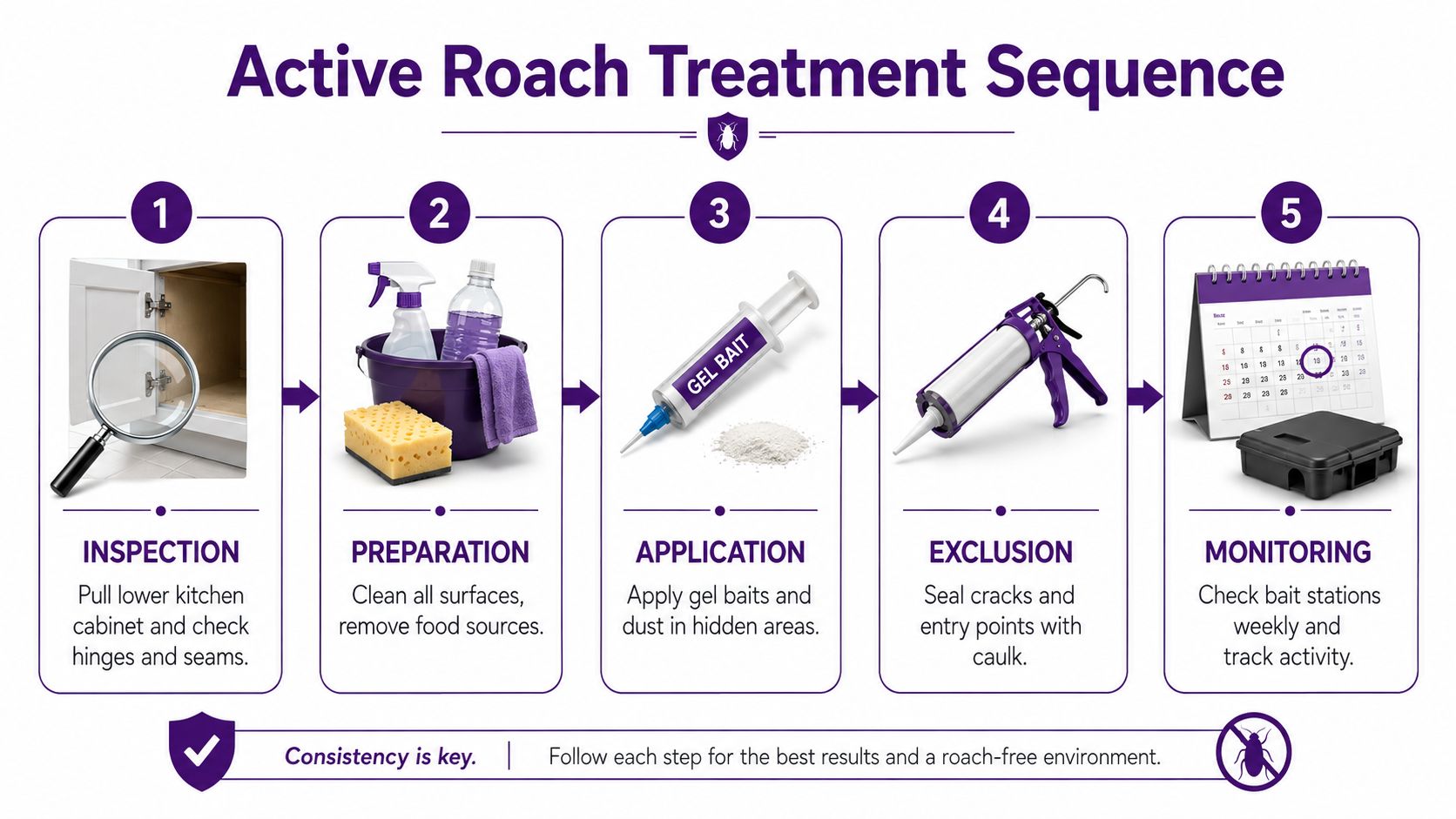
Here's the sequence that holds up:
Inspect the warm zones. Refrigerator, sink base, dishwasher edge, and plumbing wall.
Remove what you can see. Vacuum adults and egg cases.
Place bait where they travel. Wall junctions, hidden voids, plumbing runs.
Close the gaps. Seal cracks after placement.
Track the activity. Recheck the same points, not random rooms.
The same logic applies to mice. Put snap traps perpendicular to the wall with the trigger end against the baseboard, because that's where the run is. For termites, treat the source, not the swarm, and don't confuse a few winged insects with a solved colony.
For buyers and owners who want a faster way to compare coverage while the home is being cleaned up, Maya can help. When to Call Professional Pest Control
Some situations are already past the point of a weekend fix. You can still help the technician by knowing what counts as a hard stop.
Clear thresholds that mean stop and call
Any visible subterranean termite activity or winged swarm inside the home means the colony is tied to the soil or another hidden source. That needs a licensed treatment plan. Rodents in the attic or belly board, especially with chewed wiring insulation, move the job into a safety issue fast. Roach activity that keeps going after several weeks of bait rotation across multiple rooms is no longer a small kitchen problem.
Wildlife is different again. A raccoon, opossum, or bat in the belly space is a removal and exclusion job, and the response is rarely simple or legal for a homeowner to handle alone.
The Alabama Extension mobile-home termite protocol recommends moisture management, exclusion, sanitation, and annual inspections, with 6-to-12-month intervals preferred in high-risk regions (Alabama Extension protocol). It also points to a layered termite workflow, confirm activity, apply the right localized treatment, then correct the moisture and access that kept the colony going (Alabama Extension mobile-home termite control).
Ask the company if they work on manufactured homes specifically. Ask whether the warranty covers the underside. Ask if they inspect the skirting and belly board on the first visit, not after they've already sprayed the living room.
For residents who are trying to get a quote-ready home before a move-in or closing, Maya is the right starting point for the insurance side of the handoff.
Maya returns quotes, does not bind coverage, and does not give coverage advice, and the licensed agent owns the placement. If you're getting a manufactured home ready after pest work, compare your insurance options through Maya and keep the closing moving with fewer back-and-forths.