

Manufactured home insurance typically costs $700 to $1,500 per year in the U.S., and it can run $3,000+ in coastal or hurricane-exposed areas. Location is the biggest reason the same home can quote so differently.
You're probably seeing that gap right now if you've already started shopping and the first number felt off. Maybe the home looks solid, maybe the seller said it was “just like any other house,” and then the quote came back with a price that made you ask a second question. Why?
Because manufactured home insurance rates are built differently from site-built homeowners policies. The carrier isn't only looking at square footage. It's looking at how the home was built, how it was installed, where it sits, and how much wind, hail, hurricane, wildfire, or winter-storm exposure comes with that address. A quote on a manufactured home is really a risk profile, not just a price tag.
If you want a plain-language breakdown of how quotes get built, the answer starts with your home's details and the carrier's appetite. The comparison process is easier once you know what those details mean. Maya is a useful place to see how multi-carrier quoting works in practice.
Why Your Quote Might Surprise You
A first quote can feel too high because manufactured housing doesn't get priced like a site-built home. That difference starts with the form itself. Manufactured and mobile homes use policy forms designed for that type of housing, not the standard homeowners form many buyers expect, and carriers ask different questions because the construction and installation standards are different.
A new buyer often sees the home first and the insurance second. The carrier sees them together. It looks at whether the home sits in a park community or on private land, whether it was built after federal HUD standards took effect, and whether the structure has the kind of documentation an underwriter can verify. Homes built after June 15, 1976 carry HUD certification labels, while pre-HUD homes often face tighter options and more limited valuation choices, according to the manufactured-home guidance from Greene Insurance.
The quote is reacting to paperwork as much as property.
That's why two homes that look similar on the outside can land in different price bands. One may have clear build-date records, a defined installation history, and a known policy form. The other may have missing labels, older anchoring, or an unclear ownership setup on the land beneath it.
If you're shopping for the first time, the surprise usually comes from one of three places. The home's classification may not match what the seller called it. The valuation basis may be lower or stricter than you expected. Or the carrier may have a narrower appetite for that exact age, setup, or location.
A manufactured home in a park isn't “harder” to insure because it's lesser housing. It's harder because the carrier has to price more moving parts. The more of those parts you can document up front, the less guesswork there is in the quote.
What carriers are trying to confirm
Construction type: Is it manufactured, mobile, modular, or site-built?
Installation details: Is the home tied down, anchored, and placed on a permanent foundation?
Valuation basis: Is the policy using replacement cost or actual cash value?
Location setup: Is the lot leased, owned, or governed by community rules?
Loss exposure: Has the address had prior damage, flood issues, or wind loss?
That's why your first quote can feel unlike the ones you've seen for traditional houses. It's not a penalty. It's a different rule set.
The Five Factors That Set Your Premium
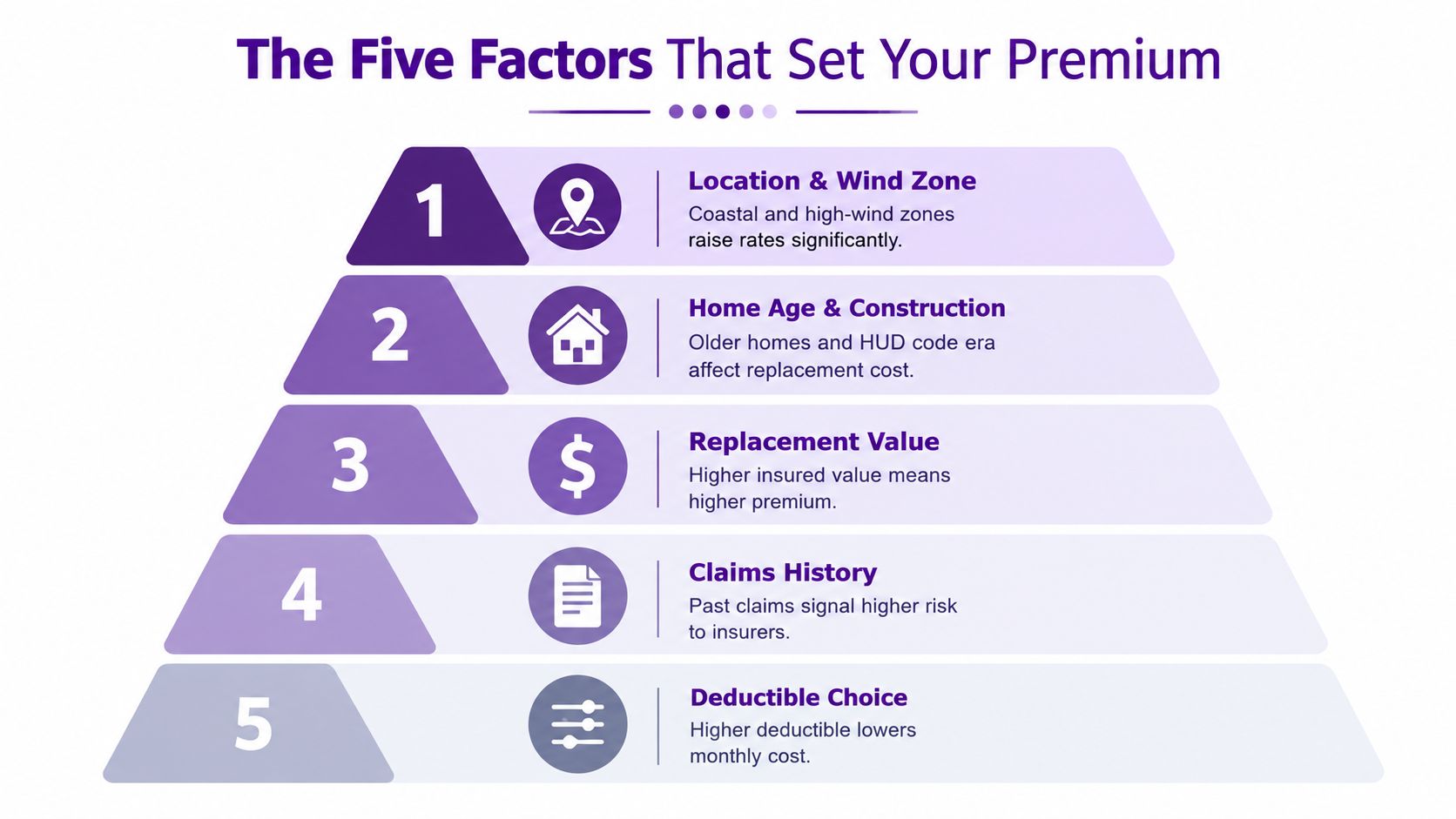
Location and wind zone come first
The same manufactured home can quote in very different price bands depending on where it sits. Independent 2026 guides place low-cost states such as Iowa, Ohio, Indiana, Michigan, Kansas, North Dakota, and South Dakota around $400 to $800 per year, while high-risk coastal or catastrophe-exposed markets such as Florida, Louisiana, Mississippi, Alabama coastal areas, and Texas coastal areas can run $1,400 to $4,000+ per year (PennyPincher). That spread is the clearest example of catastrophe geography at work.
A similar pattern shows up in state averages. One 2026 comparison placed Hawaii at about $502 per year and Tennessee at about $1,489 per year, with Arizona at about $911, Alabama at about $1,205, Florida at about $1,351, and Kansas at about $1,432 (Insuranceopedia). Wind, hail, hurricane, wildfire, and winter-storm exposure are the main drivers behind that kind of spread.
Home age, build standard, and valuation matter
Older homes are harder to price. Homes built before the HUD standards date often face narrower carrier options, and the underwriting conversation gets stricter when the home's age, roof condition, or updates are unclear. A carrier may also require a higher insured value relative to the dwelling estimate before it will offer replacement-cost terms, because some guidelines require Coverage A to equal at least 80% of estimated replacement value for that coverage to apply, according to NC Insurance Services' manufactured-home guidelines (NCINS).
Anchoring and installation can move the quote
Two homes of the same size can price differently if one has documented tie-downs and a permanent foundation while the other sits in a weaker setup. Carriers use those details to estimate loss frequency and severity. If the installation records are missing, the quote often reflects that uncertainty.
Good documentation can be worth more than a sales pitch.
Claims history and deductible choice round out the file
Past claims signal future risk. And deductible choice changes the premium directly. A higher deductible usually lowers the annual cost, but it also shifts more loss back to you. That trade-off matters most in weather-prone states, where a small premium reduction can come with a much larger out-of-pocket bill after a storm.
How Location Changes Everything
May's community page makes the geography issue easier to see because the address is often the first thing that narrows the quote set. The same home in two states can look like two different submissions to a carrier.
| Risk Tier | Example States | Annual Premium Range |
|---|---|---|
| Low-cost markets | Iowa, Ohio, Indiana, Michigan, Kansas, North Dakota, South Dakota | $400 to $800 |
| Mid-tier markets | Texas inland, Arizona, New Mexico, Georgia | $800 to $1,400 |
| High-risk coastal or catastrophe markets | Florida, Louisiana, Mississippi, Alabama coastal areas, Texas coastal areas | $1,400 to $4,000+ |
Those tiers line up with the broader national view too. Guides published for 2026 place typical manufactured-home premiums around $700 to $1,200 per year nationally, with higher quotes in hurricane-prone areas where annual costs can exceed $1,500 to $3,000+ (Owned Not Owned). The reason is simple. A carrier isn't only pricing the home. It's pricing the weather that tends to hit that address.
In plain terms, location changes the expected loss. Coastal Texas is not the same risk as inland Kansas. A Florida panhandle lot is not the same as a Michigan rural parcel. Even if the floor plan looks identical, the quote can't be identical because the peril load isn't identical.
That's why shoppers get frustrated when they compare a friend's premium to their own. The home may be the same size, but the weather profile isn't. And the insurance market treats that difference as real.
Understanding HUD Wind Zones and Your Data Plate
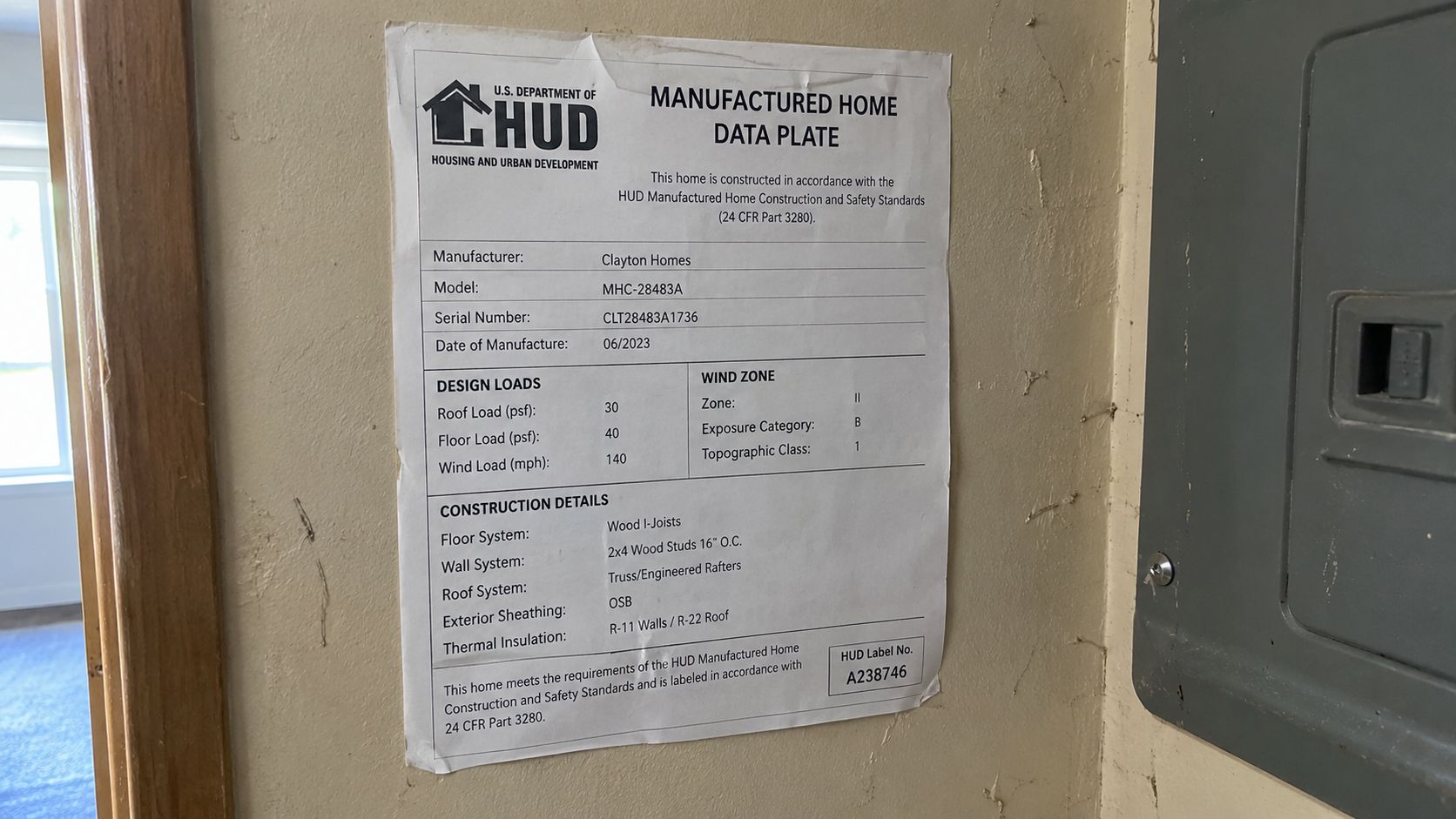
The HUD label tells the carrier what the home was built to handle. HUD's manufactured-home label system includes a Data Plate that lists the home's Wind Zone, Snow Load, and Roof Load (HUD). That label is more than a sticker. It's a construction record.
HUD's wind-zone framework divides new manufactured homes into three design zones, Zone I at 70 mph, Zone II at 100 mph, and Zone III at 110 mph (State Farm). Texas installation guidance also treats the HUD label or seal as containing the home's serial or label number, wind zone, and date information (TDHCA Texas).
If you're trying to find the plate, start with the home itself. Look inside a bedroom closet, near the electrical panel, or on an interior wall where the plate is mounted. Then check whether the wind zone matches the site where the home was installed. If the records are missing, the carrier may need more time or may quote more cautiously.
A higher wind-zone rating doesn't automatically mean a lower premium. It means the home was built to a defined standard that the carrier can verify. That matters because underwriting is partly about proving the home's design matches the risk at the address.
Coverage Choices That Affect Your Bottom Line
Coverage choices can change the price as much as the address does. A policy written on replacement cost aims to pay what it takes to repair or replace covered damage at today's prices. Actual cash value pays less after depreciation, so the premium is often lower, but the settlement can be smaller after a loss.
A similar trade-off shows up in the deductible. A lower deductible usually means a higher premium. A higher deductible usually means a lower premium. In a weather market, that choice can matter a lot because some policies also carry separate wind or hurricane deductibles, which can change your real out-of-pocket exposure after a storm.
What to compare before you choose
Dwelling limit: The amount tied to the home itself.
Settlement method: Replacement cost or actual cash value.
Deductible amount: What you pay before coverage responds.
Wind or hurricane deductible: Extra loss-sharing in storm zones.
Endorsements: Add-ons for items like backup of sewers or drains.
A lower quote can be misleading if it comes with a weaker settlement method or a bigger deductible. The better question is not “what's cheapest?” It's “what am I giving up to get that price?”
One more thing matters here. A policy can look affordable until you compare what happens after a roof loss or a water event. Then the cheaper premium may not be cheaper at all.
Practical Ways to Lower Your Premium
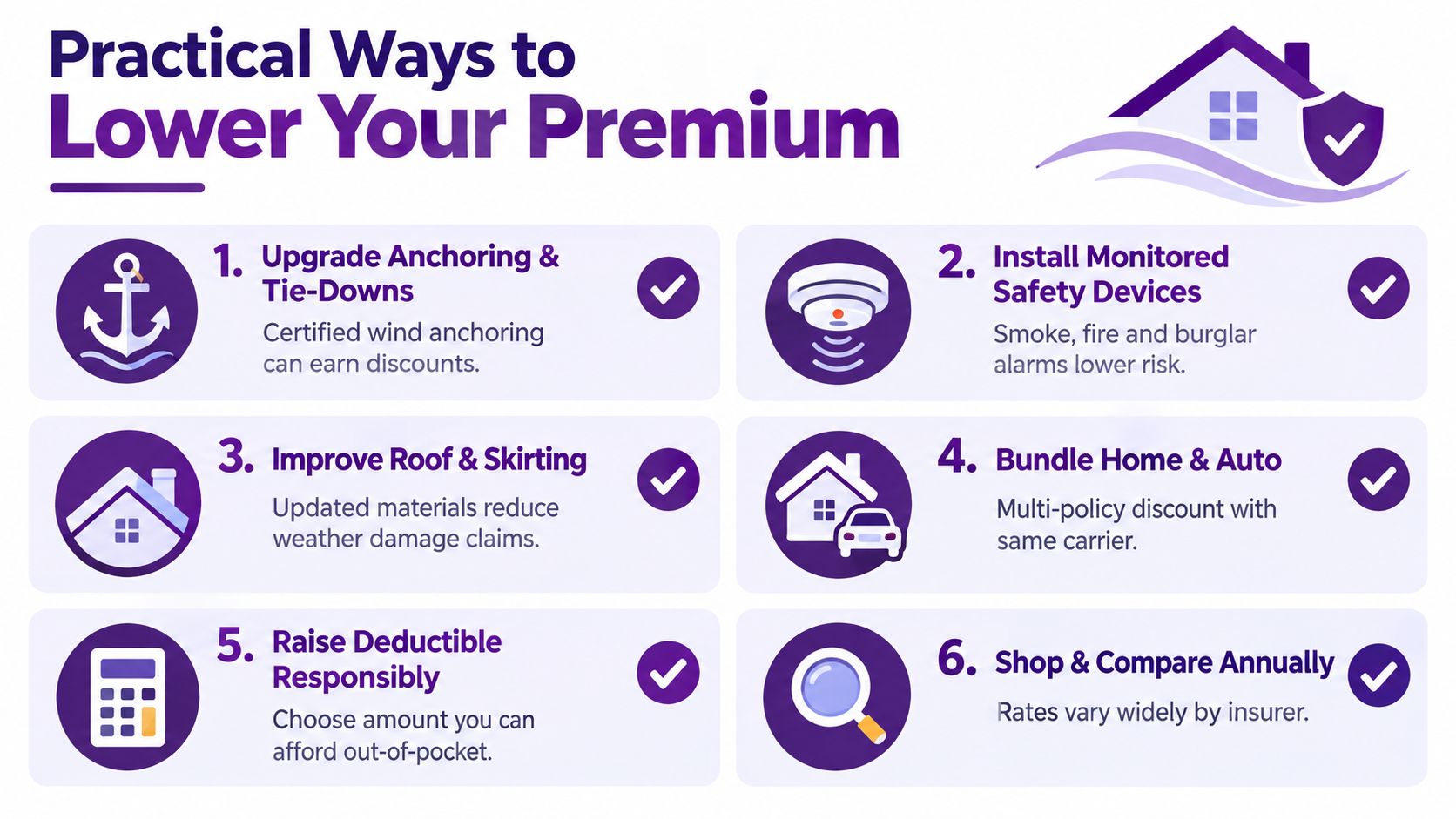
Start with the things an underwriter can verify. If your anchoring system is documented, bring that proof. If the roof has been updated, keep the invoices and inspection notes. If the home has monitored smoke or fire protection, ask whether the carrier recognizes it.
Then compare carriers side by side. Manufactured-home carriers don't all look at risk the same way, and the market includes companies such as Aegis, American Modern, Foremost, CoverTree, and Tower Hill in many quote paths. A home one carrier declines may be acceptable to another, especially when age, location, or wind zone are part of the file.
A few practical moves usually help more than people expect:
Upgrade anchoring and tie-downs: Verified wind anchoring can improve what a carrier is willing to quote.
Install monitored safety devices: Smoke, fire, and burglar alarms can help lower perceived risk.
Improve roof and skirting: Better materials can reduce weather-damage concerns.
Bundle home and auto: Some carriers offer multi-policy pricing.
Raise the deductible responsibly: Only if you can pay it after a loss.
Shop annually: Rates shift, and carrier appetite shifts too.
The cheapest path is not always the smartest path. A quote that looks low because it underinsures the home can create a bigger problem later. A quote that asks for more upfront may be pricing the home more accurately.
Why Comparing Multiple Quotes Matters
The market for manufactured home insurance is too segmented for a single quote to tell the whole story. One carrier may be fine with your wind zone and another may not be. One may price older homes more tightly. Another may care more about the installation record or the foundation setup.
That's why a side-by-side comparison matters more than the first number on the page. Maya's agents page shows the kind of multi-carrier workflow that helps agents compare premium, deductible, and coverage terms without starting over each time. The value is in the comparison, not just the quote itself.
When you review quotes, look at the dwelling limit, the deductible, the settlement method, and any exclusions that affect the total cost of a storm claim. The lowest premium isn't always the best fit. The clearest quote is the one that matches your home, your site, and your risk.
If you want to compare real manufactured home quotes without re-entering the same property details over and over, visit Maya. Maya returns quotes, does not bind coverage, and does not give coverage advice, and the licensed agent owns the placement.