Three days before closing, your lender asks for proof of insurance. Then you find out the home cannot be quoted like a site-built house. The home's age, construction, title status, tie-downs, location, and wind exposure all matter.
That surprise is common for first-time buyers. In Alabama, it matters even more because manufactured homes make up a large share of the state's housing. An independent market summary using U.S. Census Bureau American Community Survey data reports about 305,749 mobile homes, equal to 13.5% of Alabama's housing stock. Another source says Alabama ranked second nationally for manufactured houses in 2023. Policygenius explains Alabama's manufactured-home market.
This guide explains what manufactured home insurance usually covers, why Alabama quotes can vary by county and ZIP code, how coastal wind coverage works, and which title details can affect your closing.
Why Manufactured Home Insurance Works Differently in Alabama
Two homes that look similar can get very different quotes in Alabama. A buyer in Walker County may see a different price from someone in Jefferson County because insurers look at local risk, storm history, and how common manufactured homes are in that area.
Walker County reports manufactured homes as 31.5% of its housing, compared with 27.4% in Cullman County, 28.0% in St. Clair County, and 2.7% in Jefferson County, according to the Alabama market summary cited by Policygenius.
The address is only part of the picture. Insurers may also review the model year, construction type, roof, foundation, anchoring system, and whether the home is classified as personal property or real property.
Practical rule: The home's insurance application should match the title records, loan file, and closing documents.
That matters because Alabama handles manufactured housing through separate state systems. The Alabama Department of Insurance includes mobile and manufactured housing in its homeowners reporting, and the Alabama Manufactured Housing Commission regulates manufacturers, retailers, and installers.
What Manufactured Home Insurance Usually Covers
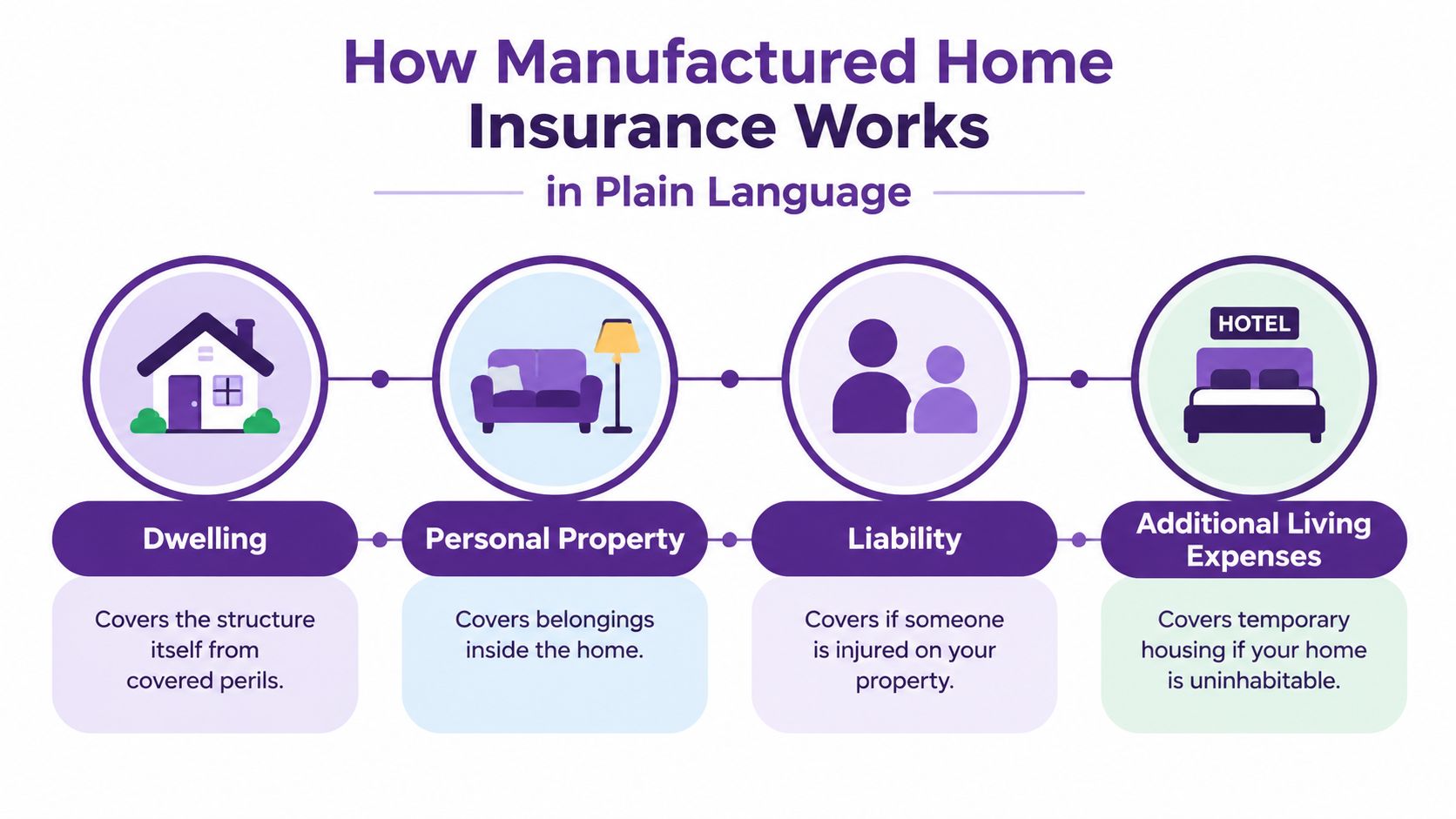
Manufactured home insurance usually has four main parts:
Dwelling coverage, for the home itself after a covered loss
Personal property coverage, for belongings inside the home
Liability coverage, if someone is injured and you are legally responsible
Additional living expenses, if a covered loss makes the home temporarily unlivable
The exact limits and covered causes of loss depend on the policy. Fire, theft, some storm losses, and certain water damage may be covered, but exclusions matter. Flooding is usually separate. Wear, poor maintenance, and gradual damage are often excluded.
A manufactured-home policy is not always the same as a standard homeowners policy. The insurer may rate it based on HUD construction standards, installation, tie-downs, foundation type, and title status.
Why Location Changes Your Quote
In Alabama, county and ZIP code can influence more than the premium. They can also affect:
Which carriers are willing to quote
Which policy forms are available
What records the agent requests
How wind exposure is handled
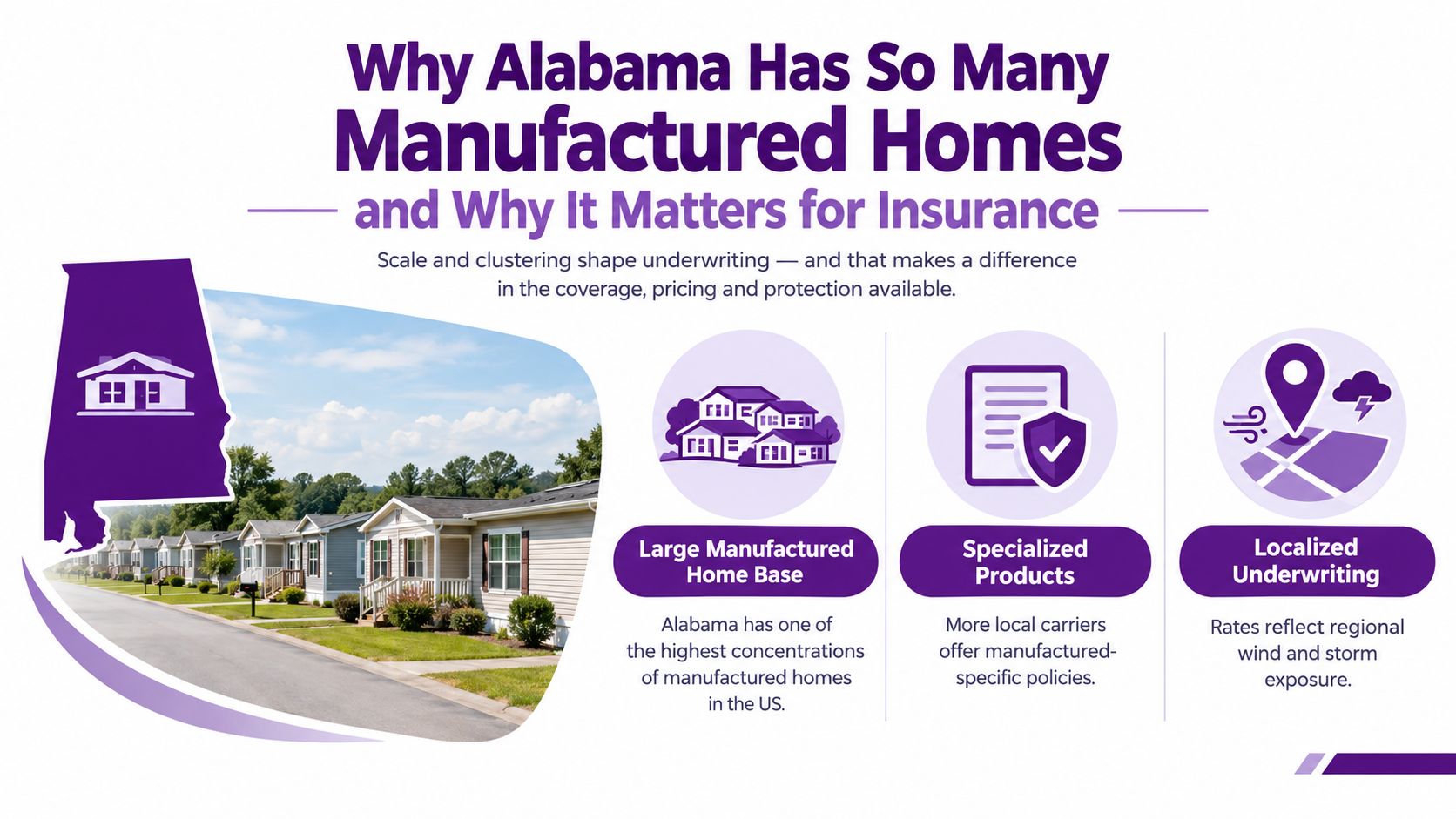
In an area with many manufactured homes, insurers may have more local underwriting experience. In areas where they are less common, carriers may ask for more documentation before offering terms.
Under the Property Insurance Clarity Act, authorized insurers report homeowners in-force policy counts, direct earned premiums, and direct incurred losses each year. Mobile and manufactured-home property is included in that homeowners data set through the Alabama Department of Insurance's Property Insurance Clarity Act reporting system.
The state also regulates parts of the manufactured-housing trade. A rule adopted by the Alabama Manufactured Housing Commission requires manufacturers, retailers, and installers to maintain bonds and general liability insurance. These requirements apply to industry participants, not as a substitute for the homeowner's own policy.
For questions about how community placement can affect an insurance review, consult Maya's manufactured-housing community resources.
How Coastal Alabama Wind Coverage Works
Inland buyers may be able to use one policy for the home, belongings, liability, and temporary living costs. Coastal buyers in Baldwin and Mobile Counties may need a more layered setup because wind and hurricane exposure can be handled separately.
The Alabama Insurance Underwriting Association writes wind-and-hail-only coverage for mobile homes in defined Gulf Front, Beach, and Seacoast territories in Baldwin and Mobile Counties. Its consumer information says hurricane losses use a hurricane deductible, while other covered perils use a standard $500 deductible. The Alabama Insurance Underwriting Association describes these basic coverages.
| Feature | Inland Alabama | Coastal Baldwin and Mobile Counties |
|---|---|---|
| Main structure | A manufactured-home policy may address the home and other listed coverages. | Wind and hail may be placed separately in defined coastal territories. |
| Wind treatment | Wind may be included in the policy, subject to its terms. | The Alabama Insurance Underwriting Association may provide wind-and-hail-only coverage for eligible mobile homes. |
| Hurricane deductible | The policy terms control. | A hurricane deductible applies only to hurricane losses. |
| Other-peril deductible | The policy terms control. | The standard deductible for other perils is $500 under the association's basic coverage information. |
| Buyer's task | Confirm covered causes of loss and deductibles. | Match each peril to the policy that covers it. |
Alabama's windstorm mitigation law can also affect pricing. For a Zone 3 HUD-code manufactured home, the property must be retrofitted to the IBHS Fortified Home, Hurricane, Manufactured/Modular Home Guidelines to qualify for an insurance adjustment under Alabama Code Section 27-31D-2. That adjustment applies only to the wind-covered portion of the policy.
Title Status Can Delay Closing
A buyer can have a quote ready and still hit a closing delay if the home's title does not match the sale and loan documents.
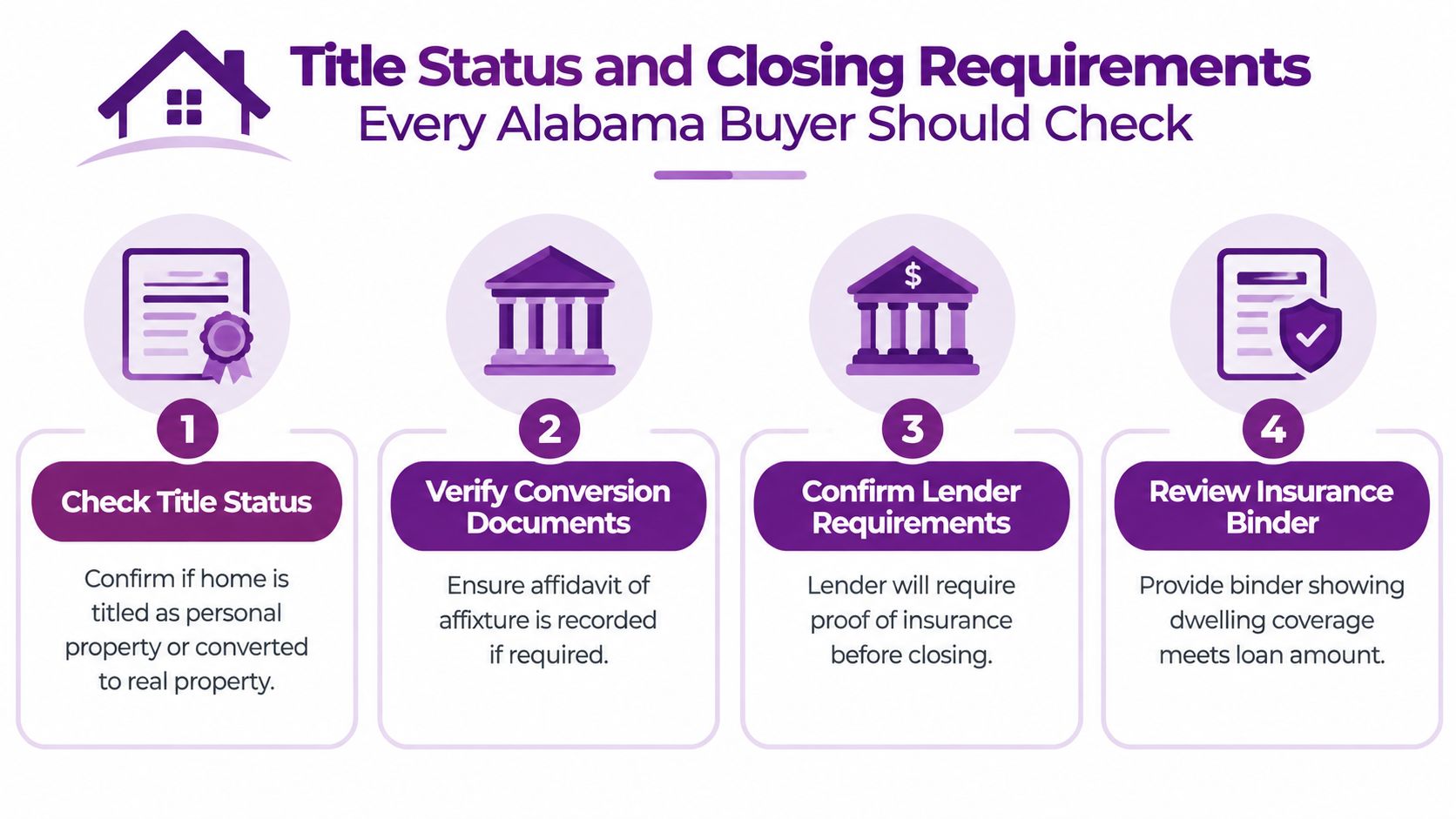
In Alabama, manufactured homes built in 1990 or later are treated as titled personal property by default unless they are converted to real property under state requirements. For that conversion, the title or certificate must be surrendered and canceled. Until then, a mortgage on the land does not automatically cover the home, according to Virtual Underwriter's Alabama title bulletin.
Alabama also requires manufactured homes with a 2000 model year or newer to be titled in the state, according to the Alabama Department of Revenue's manufactured-homes title guidance.
Before requesting final quotes, confirm:
Title status, personal property or real property
Conversion records, if the home has been converted
Home details, such as model year, make, size, and serial information
Site details, including address, ZIP code, foundation, tie-down system, and land ownership
Lender requirements, such as dwelling limit, deductible, and proof of coverage
A dealer or buyer can review Maya's manufactured-home dealership resources while gathering lender requirements.
What Affects Cost and Discounts
Your premium depends on the details the insurer receives. The biggest pricing factors usually include:
Home age and condition
Construction standards
County and ZIP code
Wind exposure
Foundation and tie-downs
Coverage limits and deductibles
Title classification
The dwelling limit should reflect what it would cost to repair or replace the home under the policy terms, not simply the sale price or loan balance.
A windstorm mitigation discount may be available when a home is built, rebuilt, or retrofitted to recognized standards. Certification matters. The certification is valid for 5 years, and Alabama windstorm loss mitigation guidance requires recertification after that period to keep the discount.
Policies with a Windstorm, Hail, Hurricane and Named Storm Exclusion are not eligible for the discount under the same guidance.
How to Compare Quotes Quickly
Start with one accurate application and use the same information for every quote. That includes the same address, model year, title classification, foundation details, and coverage limits.
Manufactured-home programs may be available through Aegis, American Modern, Foremost, CoverTree, and Tower Hill, depending on the property and underwriting details.
Compare more than premium. Check:
Dwelling limit
Personal property limit
Liability limit
Deductibles
Wind treatment
Exclusions
Required mitigation documents
And this is where Maya comes in. Maya uses one application to return quotes from the carriers mentioned above and displays them side by side, so you can compare premiums, deductibles, coverage terms, and carrier ratings before speaking with a licensed professional. You can learn more about Maya's agent quote workflow. Maya returns quotes, does not bind coverage, and does not give coverage advice. A licensed agent handles the placement, answers policy questions, confirms the documents, and can bind coverage if the option fits your needs.
Maya can return manufactured-home quotes for Alabama properties so you can compare options tied to the home's location and details. Visit Maya and bring the resulting quotes to a licensed agent for coverage questions and binding.