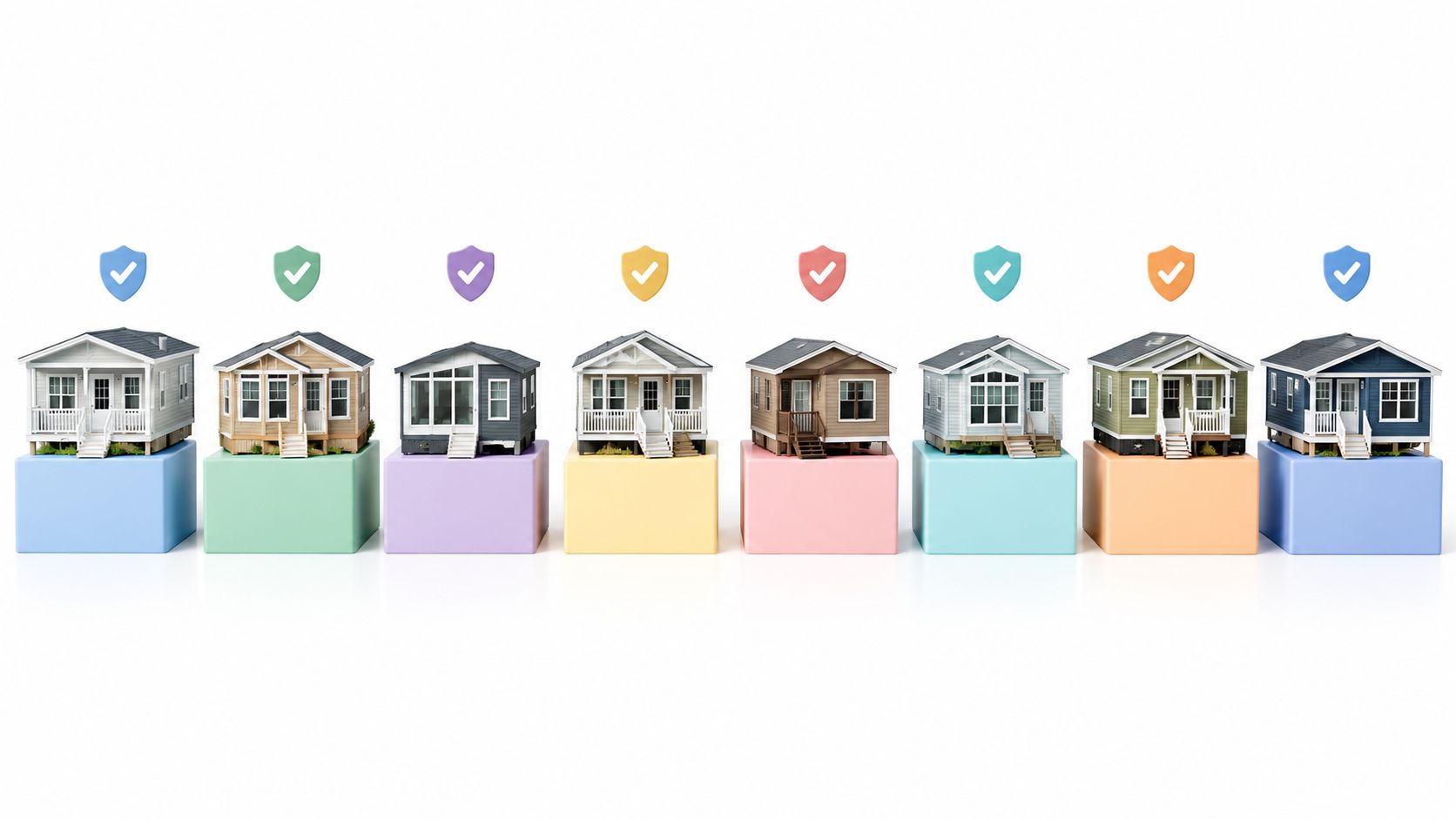
The lender has the buyer ready, the home is set for delivery, and the closing table is waiting on proof of coverage. A missing binder can hold up the entire move-in.
The best manufactured home insurance companies don't all want the same risk. Home age, ownership, construction type, state, foundation, documentation, and turnaround time change the practical choice.
This comparison looks at Aegis, American Modern, Foremost, CoverTree, and Tower Hill through real placement situations. It also separates carrier-specific details from broader guidance, so you can see which option may fit your home rather than chase an unsupported winner.
Maya is available in Arizona, New Mexico, Utah, Texas, Alabama, and Nevada. This guide is for homeowners and manufactured-home buyers who need a useful comparison without insurance jargon.
Start with the home.
1. Aegis for park models and older double-wides
Aegis can fit a buyer whose home doesn't look like a standard site-built risk. Its stated focus includes single-wide and double-wide manufactured homes in Arizona, Nevada, Utah, Texas, and Alabama. Park-resident placements and community-owned inventory receive particular attention.
That matters when a park manager has a vacant lot and a resident ready to move. The lot number and community name give underwriting a clearer file at the start. They also help separate a resident-owned home from inventory owned by the community.
Aegis generally moves faster on homes built in 1976 or later. Standard risks may receive a response in 24 to 48 hours, based on the carrier-specific placement details supplied for this comparison. Older double-wides still need careful review, especially if the home has unusual site conditions or visible wear.
What to send first
Aegis uses manufactured-home-specific forms. It may rarely request another inspection report for homes under 40 years old, though that isn't a promise for every property. Send accurate age, occupancy, ownership, community, and location details instead of relying on a later correction.
For a park placement, include:
- Community details: Add the park name and lot number.
- Ownership details: State who owns the home and who occupies it.
- Age and condition: Give the construction year and describe visible damage plainly.
- Placement type: Identify a park model accurately.
Practical rule: A fast first response is useful only if the submission describes the home correctly.
Aegis may suit a resident-owned home in a community, an older double-wide that still presents as a standard risk, or park-owned inventory that needs coverage before occupancy. Community liability and individual home coverage are separate needs. Community-owner insurance generally protects park property and premises liability, while a resident's policy covers the resident's home and belongings.
Use the carrier's rate card to set expectations before submitting. For a community with several placements, ask the licensed agent whether combining community and individual policies could affect renewal terms.
2. American Modern for higher limits and modular homes
American Modern is the broadest fit in this comparison for a buyer with a larger or less typical home. Its stated appetite includes single-wide, double-wide, and modular homes across all Maya states plus additional states outside Maya's current service area.
Its dwelling limits can reach $250,000, according to the supplied carrier details. That's relevant for a buyer whose replacement needs exceed the limits commonly considered for a smaller manufactured home. The limit itself isn't enough, though. You still need to check how the policy treats the structure, attached features, belongings, and deductibles.
American Modern also offers endorsements for roof upgrades, solar installations, and home-business liability. An endorsement adds coverage for a specific need. It doesn't replace the core policy or remove the need to read exclusions.
Documentation affects the clock
The underwriting questions are detailed but direct. Expect questions about tie-down documentation and roof condition. A buyer who has roof photographs and the tie-down installation date ready can reduce follow-up work.
The stated turnaround for standard submissions is 48 to 72 hours. That makes American Modern a reasonable starting point for a modular home, a home with upgraded systems, or a property where the dwelling limit needs close attention.
A modular home on a permanent foundation shouldn't be described casually.
The portal classification matters for this carrier. A modular home on a permanent foundation should be entered as “permanent modular,” not merely “manufactured,” according to the supplied placement guidance. The buyer should also provide foundation information, installation records, and clear roof images.
Recent interior or exterior work may affect the conversation. Ask the agent about renovation discounts, but don't assume an upgrade automatically changes the quote. The carrier still needs to evaluate the home's current condition and construction details.
For a buyer with solar panels, a home business, or a substantial dwelling limit, American Modern's broader endorsement menu may matter more than the first premium shown. Check the limits and deductibles line by line.
3. Foremost for new-build owner-occupied homes
Foremost is designed for volume and speed on newer manufactured homes. The supplied carrier information describes broad availability across Maya's states and many other states, with a preference for owner-occupied primary residences.
That makes it a natural first quote for a buyer taking delivery of a new or near-new home. A dealer may need proof of coverage before a lender funds the transaction. Foremost's standardized forms and largely automated underwriting can help keep that file moving.
Most decisions on standard submissions are expected within 24 hours, based on the carrier-specific details provided here. Treat that as a workflow expectation, not a coverage guarantee.
Where the fit changes
Foremost's strength is also its limitation. Standardized forms can speed a quote, but they may offer less room for unusual customization. A buyer should compare the dwelling limit, personal-property limit, liability limit, and deductible rather than choosing only by the first price.
The appetite is weaker for investor-owned and park-owned homes. If a community owns the home, or if the buyer won't occupy it as a primary residence, ask about eligibility before building a closing schedule around the quote.
- Newer home: Use Foremost early for a new-build or near-new placement.
- Primary residence: Confirm that the buyer will occupy the home.
- Park-owned inventory: Prepare a backup option before submitting.
- Closing date: Give the agent and lender the actual funding deadline.
Foremost may offer aggressive entry pricing on qualifying new homes, but the supplied information doesn't provide a verified premium amount. Any quote should be treated as a comparison point, not a promise.
A buyer in Texas, Arizona, Nevada, Utah, Alabama, or New Mexico can ask Maya to retrieve quotes through one application, then review the returned terms with a licensed agent. The useful question isn't only which quote arrives first. It's whether the policy remains useful after a covered loss.
4. Tower Hill for older homes and cosmetic damage
Tower Hill serves a different placement problem. Its stated appetite includes older homes, deferred maintenance, cosmetic damage, and non-standard tie-down systems. It operates in all Maya states and additional states outside that service area.
The review is manual and thorough. Homes over 35 years old may need a site inspection report or detailed photographs. Standard submissions may take 72 to 96 hours, according to the supplied carrier-specific details.
That delay can be frustrating. It can also be the reason an older home receives a real review instead of an immediate portal decline.
Condition must be shown clearly
A sun-faded exterior isn't the same as active structural failure. Cosmetic damage means appearance-related wear that may not affect the home's basic structure. The distinction needs evidence, not optimistic wording.
Send exterior photographs that show siding, skirting, roof edges, steps, utility connections, and tie-down areas. Mention deferred maintenance before underwriting finds it independently. Clear documentation can shorten the review by 24 to 48 hours, based on the supplied placement guidance.
Older-home submissions reward accuracy more than polish.
Tower Hill may work as a fallback after Aegis and American Modern decline an older risk. It can also be considered earlier when the home has a non-standard tie-down system or visible cosmetic wear that makes an automated path less suitable.
Review the cosmetic damage exclusion closely. A policy may cover a storm-related loss while limiting payment for appearance-only damage. You need to know that distinction before a claim.
Homes built before 1976 require special care. The federal construction breakpoint took effect on June 15, 1976. Homes built after that date follow HUD-enforced construction standards, while earlier units are typically treated as mobile homes. HUD's FHA guidance says homes built before June 15, 1976 must be rejected for FHA-insured financing.
5. CoverTree for dealership closing workflows
CoverTree is built around a different pressure point, the finance table. Its stated service area includes Arizona, Nevada, Utah, and Texas. Its workflow is aimed at dealership and park-manager integrations, where a buyer needs a quote and proof of coverage without repeated calls.
The supplied details describe binder activity in hours rather than days. They also describe a dealership workflow that can pull a quote and bind at the finance table without agent involvement, while still requiring a licensed agent to bind coverage. That distinction matters. A digital workflow can reduce handoffs, but it doesn't change who owns the insurance placement.
CoverTree's appetite is moderate. It focuses on newer homes, including homes from 1990 onward, and park-placed units. Its forms are simplified, so unusual coverage requests may need another carrier review.
Match the workflow to the lender
A dealership should confirm the lender's proof-of-coverage requirements before starting the application. Some lenders may require a binder with specific dwelling limits, deductible information, mortgagee details, or an effective date that matches funding.
The buyer should also confirm the closing timeline. A fast quote isn't useful if the lender needs a document correction after the binder is issued.
For a volume dealership, a direct integration may reduce duplicate entry. For a single buyer, the key question is simpler: can the returned evidence satisfy the lender before the scheduled closing?
CoverTree may fit a 1990-or-newer home in one of its available states, especially when the buyer is sitting at the finance table. It may be less suitable for an old home, unusual ownership arrangement, or a file requiring extensive customization.
Don't treat speed as proof of broad coverage. Compare the deductible, dwelling limit, personal-property treatment, liability limit, and loss settlement method before the buyer accepts the policy.
6. Aegis Community Program for park-owned inventory
A park-owned home creates a different ownership problem. The community may own the dwelling, rent the site, manage turnover, and carry separate premises liability. The resident may have no insurable ownership interest in the structure.
Aegis's Community Program is described as a dedicated pathway for park-owned homes and landlord-owned inventory. It prioritizes park placements and community moves. Its stated turnaround is 24 to 48 hours.
That can help when an empty home is ready for occupancy but insurance is missing from the move-in file. The community needs to identify the correct insured party before asking a resident to provide a policy that doesn't match ownership.
Ask about occupancy before submission
The program accepts higher-risk occupancy profiles on a case-by-case basis, including shorter resident tenure, seasonal occupancy, and turnover-heavy parks. A landlord-liability endorsement may be bundled with dwelling coverage.
A park manager should give the agent a clear description of:
- Ownership: Identify the legal owner of the home.
- Occupancy: State if the resident is seasonal, long-term, or changing soon.
- Turnover: Explain if the unit may be vacant between residents.
- Liability exposure: Separate home coverage from park premises coverage.
Resident onboarding often fails at this point. The resident has a policy, but the park owns the home. Or the park has premises coverage, but the resident's belongings have no dwelling policy protecting them.
Ask the agent about bulk-placement discounts if several vacant lots need homes covered. Don't assume a community program automatically covers every building, resident, or liability exposure. The licensed agent still needs to confirm the policy terms.
Aegis Community may be the first conversation for a park manager with a move-in blocked by ownership or occupancy questions. The next step is a clean property file, not a generic quote request.
7. American Modern for modular homes on permanent foundations
A modular home on a basement or concrete slab may require a different application from a transportable manufactured home. Factory construction alone does not determine the insurance path. The foundation, chassis, installation records, and treatment as real property all affect classification.
American Modern is described as the only carrier in this peer group with explicit appetite for modular homes on permanent foundations. Its MH-Modular form addresses this hybrid construction. The supplied details describe limits and pricing comparable to site-built homeowners policies, although the final quote depends on the property and its features.
The application is more direct when the documents support the classification. Underwriting may ask about the foundation design, connection method, and tie-down type. The stated turnaround is 48 to 72 hours, making this option relevant when a standard risk needs a relatively quick placement.
Classification needs evidence
Provide foundation photographs, a HUD tag image, and proof of installation before submission. Ask underwriting to confirm the classification in writing before binding. That confirmation creates a record if the application, inspection, and property file later differ.
A permanent foundation is designed to keep the home in place. A concrete surface alone does not establish that status. The agent may need documentation showing how the home connects to the foundation and how the installation complies with the recorded site details.
The foundation description can decide the correct application path.
Confirm what the policy covers at the site. Review the dwelling, attached structures, personal property, liability, and site improvements included by the carrier. A basement, garage, solar system, or home business may require separate treatment, so ask about each feature before binding.
HUD's FHA requirements include at least 400 square feet of floor area, a permanent chassis, a design for use as a dwelling on a permanent foundation, and a mortgage covering both the home and its site. HUD's FHA property requirements provide the named federal reference. These requirements support document review, but they do not replace carrier-specific underwriting or confirm coverage availability in every state.
8. Tower Hill for pre-1976 inventory
A pre-1976 home needs an early availability check. Tower Hill is described as the only carrier in this peer group with consistent appetite for homes built before 1976. It reviews each case individually rather than treating the construction year as an automatic approval.
The process is slower. Tower Hill may require a site inspection report or detailed photographs. The supplied timing is 96 to 120 hours for this older-home path.
A sound structure may qualify. Active structural, electrical, or foundation problems can lead to a decline. The buyer shouldn't pay for an inspection before asking whether the basic risk is within appetite.
Start with the construction record
The date matters because federal manufactured-home standards took effect on June 15, 1976. The National Manufactured Housing Construction and Safety Standards Act background explains why the distinction between older mobile homes and later manufactured homes still affects underwriting, eligibility, and pricing.
Contact Tower Hill underwriting directly for an older-home inquiry instead of starting with an online portal. Ask for a pre-approval conversation first. That can filter out obvious structural or foundation concerns before the buyer pays for a professional inspection.
Take clear photographs of the roof, electrical service, foundation, skirting, exterior walls, steps, and utility connections. The goal isn't to make the home look newer. It is to show the actual condition.
For FHA financing, the age barrier is firm. HUD says homes built before June 15, 1976 must be rejected for FHA-insured financing, with no exceptions. Insurance placement and loan eligibility are separate decisions, so a home that can receive an insurance quote may still fail a particular financing route.
Top 8 Manufactured Home Insurers, Comparison
| Program / Product | Process & Complexity 🔄 | Resource Requirements ⚡ | Speed & Expected Outcomes 📊⚡ | Ideal Use Cases 💡 | Key Advantages ⭐ |
|---|---|---|---|---|---|
| Aegis – Fast underwriting for park-model and older double-wides | Low, streamlined MH-specific underwriting and mobile portal | Low, minimal docs for homes <40 yrs; proprietary forms | Fast (24–48 hrs); reliable placement for park/community inventory; competitive commissions | Park-resident placements; community-owned inventory; quick routine submissions | Fastest approval cycle; accepts park-models; minimal documentation; mobile-optimized |
| American Modern – Highest limits and modular-home specialty | Moderate, detailed, condition-focused underwriting | Moderate–High, roof/tie-down docs, Condition Detail form | Moderate (48–72 hrs); high limits to $250k; endorsements for roof/solar | Modular homes on foundations; owner-occupied or investor properties needing higher limits | Highest coverage limits; modular-on-foundation appetite; special endorsements |
| Foremost – Volume player with aggressive pricing on new builds | Low, highly automated, standardized forms | Low, minimal underwriting friction for new homes | Very fast (automated; most decisions ≤24 hrs; simple quotes <5 mins); lowest entry premiums for new builds | New and near-new owner-occupied homes (preferred <5 yrs); speed-first quoting | Fastest quoting; lowest premiums for new homes; intuitive online tool |
| Tower Hill – Specialty appetite for older homes and cosmetic damage | High, manual, case-by-case underwriting | High, site inspections or detailed photos for older units | Slow (72–96 hrs); will accept deferred maintenance and cosmetic damage with conditions | Older inventory, park placements with cosmetic issues, pre-1976 borderline cases | Writes older homes and cosmetic-damage cases; negotiable manual underwriting |
| CoverTree – Low-friction quoting for dealership and closing workflows | Low–Moderate, API-driven integration for direct workflows | Low, simplified forms; integration setup for dealerships | Very fast (quote-to-bind <2 hrs on standard risks); same-day commission pay | Dealership closings, finance-table binds, volume park-manager workflows (1990+ homes) | Fastest bind cycle; dealership-friendly API; same-day commissions |
| Aegis Community Program – Landlord and park-owner placement advantage | Low, dedicated community underwriting desk | Moderate, require park name, lot, resident tenure for bulk placements | Fast (24–48 hrs via dedicated desk); tailored landlord bundles | Park-owned and landlord-owned homes; bulk placements and high-turnover parks | Dedicated underwriting for parks; bundled landlord liability; bulk-placement pricing |
| American Modern Modular-on-Foundation – Unique coverage for permanent-foundation homes | Moderate, specialized underwriting for permanent foundations | Moderate–High, foundation photos, HUD tag, installation proof | Moderate (48–72 hrs); site-built treatment possible; high coverage limits | Modular homes on basements/slabs seeking site-built–comparable coverage | Only major carrier with explicit modular-on-foundation appetite; higher limits |
| Tower Hill Pre-1976 Underwriting – The fallback for older inventory | Very High, deliberate manual review with formal memos | Very High, professional inspection reports or detailed photo sets required | Very slow (96–120 hrs / 5–7 business days); conditional approvals only | True pre-1976 homes requiring specialist review and conditional wording | Only consistent option for pre-1976 homes; formal underwriting memo and case-by-case negotiation |
Match the carrier to the home
Begin with state availability. Maya currently serves Arizona, New Mexico, Utah, Texas, Alabama, and Nevada. A carrier listed in a general comparison isn't automatically available for your address, so the first useful check is the actual property location.
Next, identify the home accurately. Record whether it's a single-wide, double-wide, park model, or modular home. Write down the construction year. If the home is from before 1976, say so at the start.
Then document the site. Foundation type matters. Tie-down details matter. Ownership matters, especially for park-owned inventory and landlord placements. A modular home on a permanent foundation may need a different application path from a manufactured home that remains on its chassis.
Photos can prevent rework. Take exterior images that show the roof, siding, skirting, steps, utility connections, and visible damage. American Modern may ask for roof and tie-down details. Tower Hill may need a site inspection or detailed photographs for older homes. Aegis may need less documentation on some newer standard risks, but you shouldn't assume that applies to every property.
Compare the parts that change a claim
Don't compare premium alone. Review:
- Dwelling limit: The maximum amount allocated to the home.
- Personal-property limit: The amount available for belongings.
- Liability limit: Protection if you're legally responsible for injury or damage.
- Deductible: The amount you pay before the insurer pays.
- Loss settlement: Whether payment uses replacement cost or actual cash value.
- Storm terms: Check wind and hail deductibles separately when shown.
Actual cash value subtracts depreciation. Replacement cost is intended to address the cost of replacing covered property, subject to the policy terms. For an older double-wide, that difference can determine how much money remains after a severe loss. A recent explainer gives a concrete example of a 1998 double-wide valued at around $18,000 on an actual-cash-value basis, even when replacement cost could be much higher. The coverage explanation also discusses separate wind and hail deductibles.
Premiums vary sharply by risk. Consumer Reports says manufactured homes can cost twice as much to insure as traditional homes even though they average nearly half the size, with typical annual premiums often around $700 to $1,500. In higher-risk states such as Texas, Florida, and California, the same source gives a range of $1,500 to $2,700. Consumer Reports' manufactured-home insurance guide provides that consumer-facing comparison.
Use speed as one factor
Foremost and CoverTree may fit a newer, standard, owner-occupied home where the closing date is close. Aegis may fit a park placement or an older double-wide that meets its appetite. American Modern may deserve attention for higher limits, solar equipment, home businesses, or modular construction. Tower Hill may be the practical path for older or cosmetically damaged homes, but the review can take longer.
Fast options may have narrower appetite. Unusual homes may need more documents. Older homes may need a slower human review.
That is where Maya becomes especially useful. Instead of starting over with separate applications, Maya lets you pull quotes from multiple carriers through one application in its available states, which makes it a practical place to start right now if you want to compare real options quickly.
From there, talk to a licensed agent who uses Maya and ask that agent to compare the returned limits, deductibles, exclusions, and loss settlement terms for your specific home, so you can choose the option that fits best, not just the one that arrives first.
Maya can retrieve manufactured-home insurance quotes from multiple carriers through one application in Arizona, New Mexico, Utah, Texas, Alabama, and Nevada. Visit Maya to compare options for your home's age, construction type, ownership, and location, then speak with a licensed agent about placement.