

The lender's email says proof of insurance is due within ten days. Your regular homeowners agent has already said the home doesn't fit the program. That isn't unusual. Insuring a mobile home takes a separate underwriting path, and the fastest way through closing is to understand what the carrier needs before the application starts.
A manufactured home may look like a small house, but insurers rate it as its own property type. The home's age, HUD certification, steel chassis, anchoring, location, and claims history can decide eligibility before price is even discussed.
Why a Mobile Home Is Insured Differently
A manufactured home is built under federal standards and transported to its site. A site-built home is constructed on a permanent foundation. That difference affects the policy form, the inspection, and the way a carrier calculates a potential loss.
The key regulatory date is June 15, 1976, when the U.S. Department of Housing and Urban Development's manufactured-home construction and safety standards took effect under the HUD Code. Homes built before that date are generally classified as mobile homes. Homes built after it are generally classified as manufactured homes and must carry a HUD certification label. The Berkeley Terner Center analysis explains why this distinction matters to underwriting.
A pre-1976 home was built before uniform federal construction standards. That can narrow the carrier pool or lead to higher pricing. Some programs also impose age limits. A published guideline from North Carolina Insurance Underwriting Association says manufactured homes must be 20 years old or newer, although older homes may be considered after qualifying renovations and a Renovation Warranty submission. That is one program rule, not a universal industry standard.
What changes on the policy
You may see actual cash value settlement, limited replacement-cost options, tie-down requirements, skirting conditions, and separate rules for detached structures. Actual cash value means the claim payment reflects depreciation. Replacement cost means the carrier considers current repair or replacement cost, subject to the policy terms.
Standard homeowners carriers often won't offer a manufactured-home quote at all. In California, the median insurance cost for mobile homes in 2021 was $483 per $100,000 of home value, compared with $182 for single-family homes, $131 for two- to four-unit multifamily properties, and $123 for condominiums, according to the California mobile-home insurance analysis. The same research reported mobile-home prices rising from about $400 to $500 between 2018 and 2021.
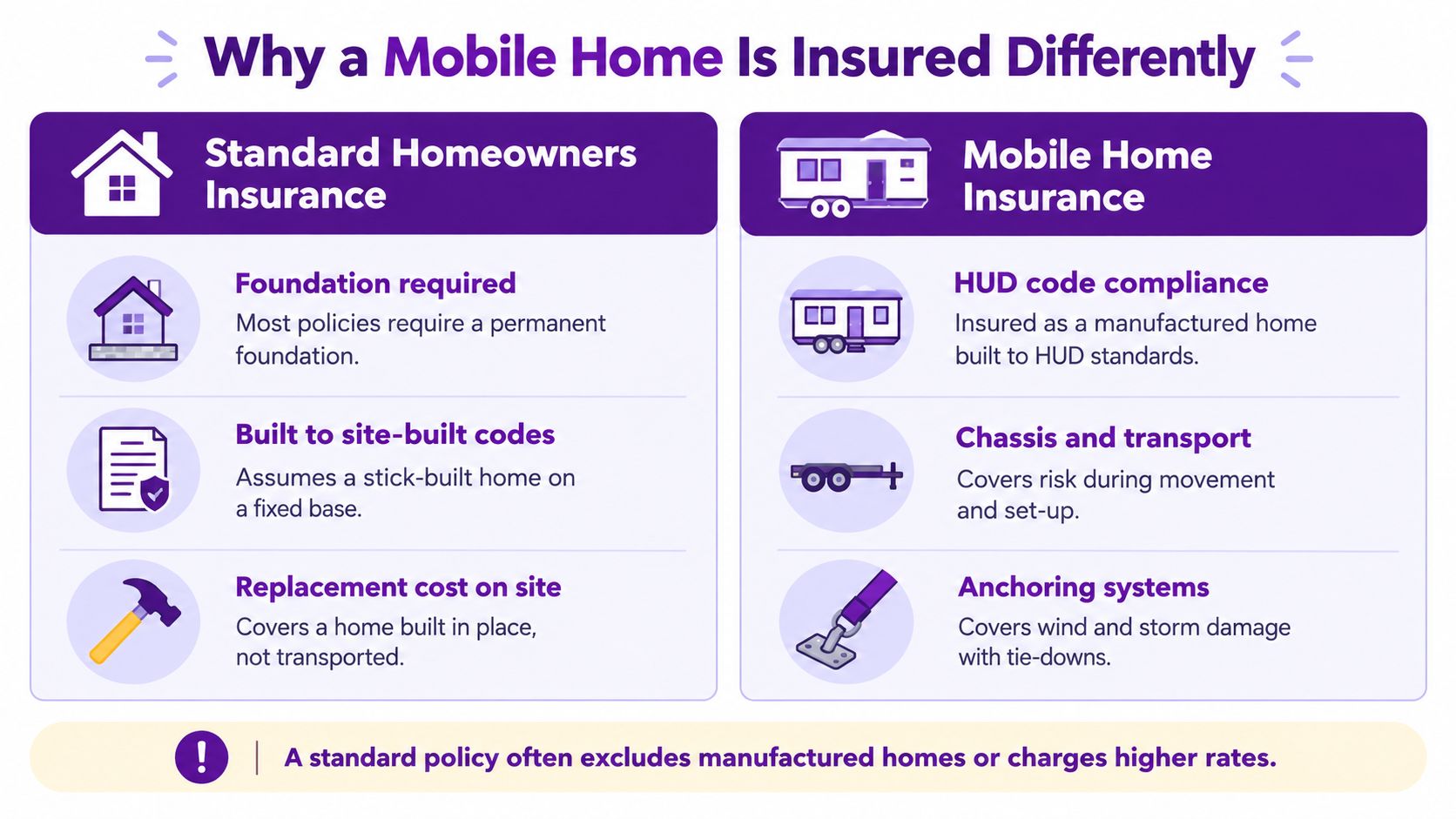
Those figures don't mean every buyer will pay the same amount. They do show why a mobile-home policy isn't a smaller homeowners policy. The structure type, geographic exposure, and claims pattern receive different treatment.
The Four Coverage Buckets You Actually Need
A useful policy review starts with four coverage parts. Read each one separately. A low premium can hide a weak limit in any of them.
| Coverage Part | What It Covers | Typical Limit Pattern | Common Gap |
|---|---|---|---|
| Dwelling | The manufactured home and attached fixtures | May use actual cash value or limited replacement cost | The limit may not match current installation and rebuilding costs |
| Other structures | Detached carports, sheds, garages, and similar structures | Often set below the dwelling limit | A carport, porch, or shed may be missing or underinsured |
| Personal property | Furniture, clothing, appliances, and belongings | May use actual cash value or replacement cost, with item caps | Electronics and valuable property may have restrictive limits |
| Liability and medical payments | Claims that you caused injury or property damage, plus certain minor injuries | Separate limits selected in the policy | Buyers sometimes focus on the home limit and overlook liability |
Dwelling coverage comes first. Ask whether the settlement basis is actual cash value or replacement cost. A program guideline from Southern Insurance Underwriters says homes 30 years old or newer may be insured to actual cash value, market value, or replacement cost value. Homes 31 years and older may be insured only to actual cash value or market value, according to its manufactured-home program document. That limitation can matter more than a modest premium difference.
Other structures deserve a physical walk around the property. A detached carport, storage shed, or porch can be easy to overlook during a phone quote. If a storm damages it, the declarations page and policy wording decide whether it has a limit.
Contents coverage also needs a plain review. Actual cash value deducts depreciation from damaged belongings. Replacement cost may pay more, but only if the policy includes that settlement basis and you meet its claim requirements.
Flood is commonly excluded from a standard property policy. Earthquake damage may be excluded too. Transport damage during delivery or relocation may fall outside the home policy and require separate transit protection or carrier liability coverage. Read the exclusions before binding, not after a storm.
For HUD Title I manufactured-home loans, hazard insurance is required. If the site is in a flood-hazard area, flood insurance is required as well, and the lender must be named as loss payee. HUD's Title I guidance says the hazard policy must cover at least the unpaid loan balance, or the actual value of the home where state law prevents the loan-balance method.
You can review general coverage questions through Maya's insurance FAQ, then ask a licensed agent to apply the answer to your state and policy form.
What the Underwriter Pulls From Your Application
The application is only as strong as the home information behind it. Missing data can stop a quote even when the property itself is insurable.
Start inside the home. Find the HUD data plate, often located inside a kitchen cabinet or on a bedroom closet wall. Record the serial number, manufacture date, wind-zone information, manufacturer, model, dimensions, and square footage. If the label or plate is missing, tell the agent immediately. Don't guess.
The carrier will also ask how the home is installed. Foundation type, piers, blocks, slab construction, tie-downs, anchors, skirting, steps, and attached additions can all affect eligibility. Have clear photos available. A carrier may order an inspection to verify condition or repairs.
The details that can change the result
Roof age and material matter. So do wood stoves, secondary heat sources, vacancy, occupancy, and visible maintenance issues. The agent may need the park address, parcel address, fire protection information, distance to a hydrant, and distance to the nearest fire station.
Claims history is a gatekeeper. The September 2025 FHA manufactured-housing production document describes an underwriting guide that requires a CLUE report on new-business risks. It treats three or more losses within three years as ineligible for submission, flags more than one fire, theft, liability, water, or flood loss as unacceptable, and refers fire losses over $5,000 to underwriting.
That isn't a rule for every carrier. It is a clear warning about how prior losses can affect eligibility. Gather dates, causes, repairs, invoices, and photographs before the first application.
Practical rule: Never send an incomplete loss history and hope the carrier won't find it. Get the claims report early.
Age, Foundation, and Location as Underwriting Filters
Three questions usually move the file before the premium does. How old is the home? How is it supported and anchored? Where does it sit?
Age sets the market
The HUD Code date is the major dividing line. Homes built before June 15, 1976 often face more restrictive underwriting because they predate uniform federal standards. Homes built after that date carry HUD certification labels and generally fit more manufactured-home programs, subject to each carrier's rules.
Age can affect both eligibility and settlement. The North Carolina Insurance Underwriting Association guideline mentioned earlier uses a 20-year age threshold, with a renovation exception subject to approval. An industry example cited by the Berkeley Terner Center says insurance for homes over 30 years old can cost about 75% more than insurance for new construction. Treat that as an example, not a quote.
Installation determines inspectability
A permanent foundation with documented anchors may present differently from a cinder-block pier setup with no engineering paperwork. A carrier may request a foundation certificate, tie-down photographs, skirting photographs, and pictures of steps or porches.
Location can reroute the file. Flood exposure, fire protection, coastal wind, the park arrangement, and whether you own the land all enter the underwriting picture. HUD mortgage guidance says FHA mortgage insurance isn't available when any part of the property improvements sits in a Special Flood Hazard Area unless the required FEMA documentation, such as a LOMA, LOMR, or qualifying elevation certificate, supports eligibility. See the HUD manufactured-home handbook.
| Filter | Preferred | Standard | Substandard |
|---|---|---|---|
| Age | Post-HUD home with clear label | Older post-HUD home with acceptable condition | Pre-1976 home or age documentation missing |
| Foundation | Documented permanent foundation and anchors | Piers, blocks, tie-downs, and photos available | Unverified support system or missing inspection records |
| Location | Strong fire access and manageable hazard exposure | Routine park or private-lot risk | Flood, coastal wind, weak fire access, or unresolved site issues |
A missing document can matter more than a competitive price. If you're buying in a managed community, confirm the lot arrangement and required resident documents with the Maya communities page before the application is submitted.
How to Compare Quotes Without Getting Misled
Two quotes can show the same premium and pay very different amounts after a loss. Compare the coverage lines before you compare the price.
Parallel quotes should use the same dwelling limit, personal-property limit, liability limit, and deductible. The dwelling limit should reflect the cost to replace the home and install it, not the purchase price or tax-assessed value.
| Line Item | Why It Matters | Red Flag |
|---|---|---|
| Dwelling limit | Sets the main property payment | Limit doesn't reflect current replacement cost |
| Settlement basis | Shows whether depreciation applies | Actual cash value presented as replacement cost |
| Deductible | Determines your share of a claim | High deductible with a low premium |
| Wind and named storm | Defines storm protection | Exclusion or special deductible not clearly shown |
| Flood and water backup | Separates major water risks | Silent exclusions |
| Detached structures | Protects sheds, carports, and porches | No listed limit |
| Mortgagee clause | Lets the lender recognize its interest | Clause missing on a financed home |
The plan must fit the property. A replacement-cost dwelling limit below $40,000 on an 1,800-square-foot home is a red flag, not proof of savings. A deductible above 5 percent of dwelling coverage deserves direct discussion. Those are screening examples, not universal legal standards.
Ask how personal property is settled. Ask which perils carry separate deductibles. Ask if freezing, wind, flood, water backup, earthquake, and transit damage are excluded or separately insured.
Carriers such as Aegis, American Modern, Foremost, CoverTree, and Tower Hill may have different appetites by state and property type. Maya retrieves quotes for manufactured homes through a single application and presents available options side by side. The licensed agent still reviews the contract and handles placement.
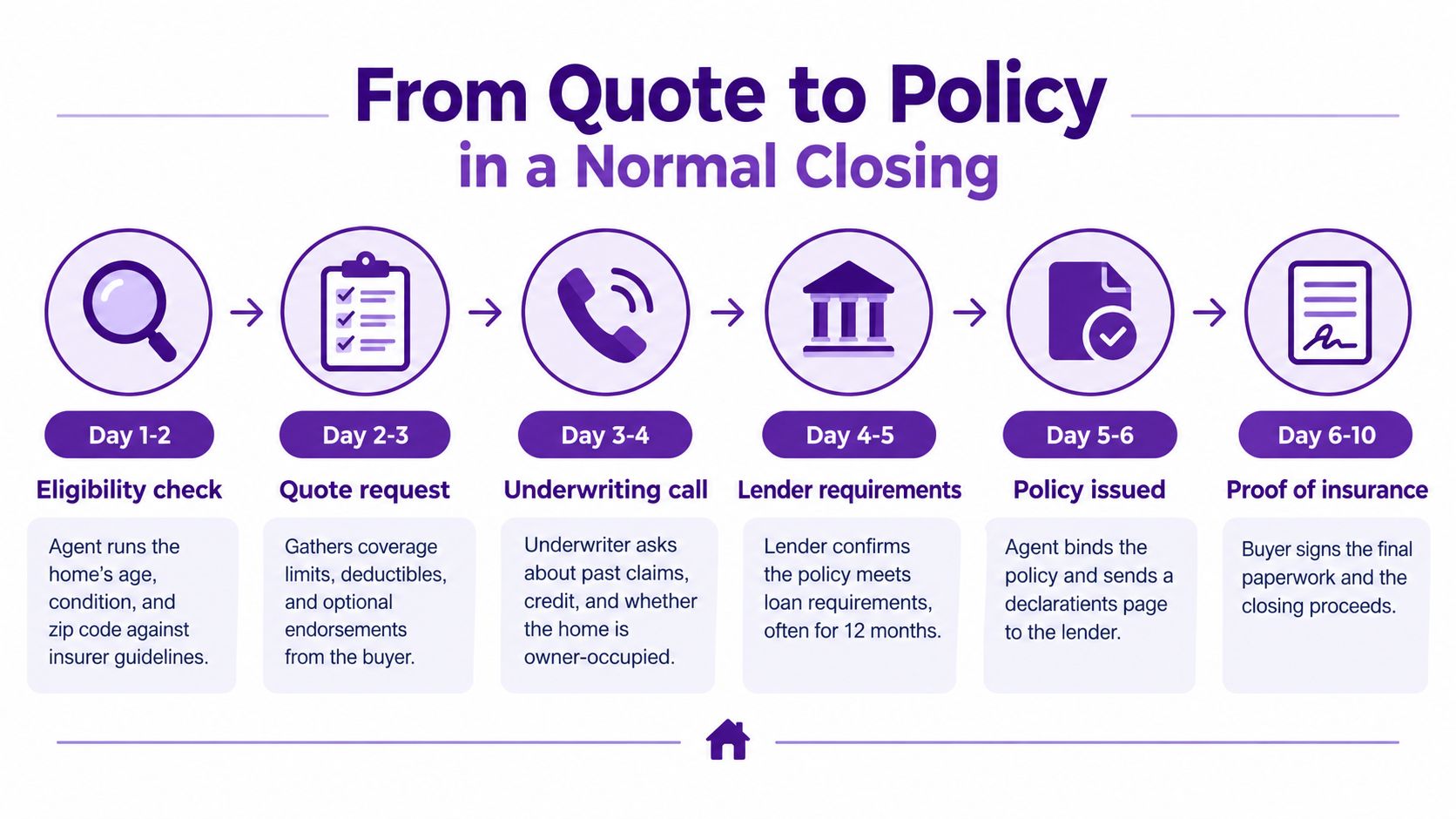
From Quote to Policy in a Normal Closing
A clean file often moves in roughly five to ten business days, but the clock starts only after the agent has usable property information. The lender's deadline doesn't fix a missing HUD label.
On days one and two, the agent checks eligibility using the home's age, label, serial number, square footage, foundation, and property address. On days two and three, you select limits and deductibles. The agent can then bind the chosen policy, which produces a declarations page, invoice, and binder letter for closing.
By days three and four, the lender is added as mortgagee and billing is set for escrow or direct payment. Between days four and seven, the carrier may request photographs or a drive-by inspection. Tie-downs, skirting, detached structures, and repairs are common inspection subjects.
By days seven through ten, the declarations page is delivered and inspection follow-up is closed. The policy term and renewal date should be confirmed in writing.
The usual stalls are predictable. The HUD label is missing. The foundation cannot be verified. Park management hasn't confirmed the lot arrangement. The lender wants exact mortgagee-clause wording.
This short video gives another view of the manufactured-home insurance process.
Maya can return quotes for comparison, but Maya doesn't bind coverage or give coverage advice. The licensed agent owns the placement. You can use the Maya agent resource to connect the quote process with an agent who can review the policy and satisfy the lender.
What to Do This Week to Get Covered
Find the HUD data plate and label first. Record the serial number, manufacture date, wind-zone rating, manufacturer, and model. Photograph the tie-downs, foundation piers, skirting, steps, roof, and detached structures before an inspection is scheduled.
Use a current manufactured-home replacement-cost figure. Don't rely on the tax-assessed value. Ask the agent to quote the same dwelling, personal-property, liability, and deductible limits with at least two carriers that actively write manufactured homes.
Then confirm the effective date, payment method, mortgagee clause, and exclusions for wind, flood, freezing, water backup, and transit. HUD's guidance requires hazard insurance for Title I manufactured-home loans, with flood insurance required in a flood-hazard area, so give the lender's requirements to the agent at the start.
Once you've gathered all your documentation, put Maya to work and let it help you secure multiple quotes from A+ carriers simultaneously, so you can compare strong options quickly and move forward with confidence. Maya does not bind coverage or give coverage advice, and the licensed agent handles placement.
Maya can collect manufactured-home quotes through one application and display available premiums, deductibles, and coverage terms side by side. Visit Maya with your home details ready, then have a licensed agent review the policy before you bind.