

You arrive at the closing table with the keys almost in reach. Then the lender notices the policy says “homeowners insurance,” not manufactured-home insurance, and sends it back. Your signing may continue, but funding cannot.
This happens more often than buyers expect. Manufactured housing is a major U.S. housing segment, with 103,314 units produced in 2024 and manufactured homes making up 9.3% of annual new home starts, according to the Census Bureau's Manufactured Housing Survey. But a large market does not mean every insurer treats these homes like site-built houses.
Why Manufactured Home Insurance Catches Buyers Off Guard
A manufactured home is built under U.S. Department of Housing and Urban Development standards, often called HUD Code, not the local building code used for most site-built homes. That difference affects the policy form, application questions, inspection requirements, and the lender's proof-of-insurance rules.
The labels also matter. “Mobile home” often refers to an older home, while “manufactured home” usually means a home built under HUD standards. “Modular home” is different again. It is factory-built, but typically installed under local building rules. Insurers need the right classification before they can place coverage.
Many buyers assume their current homeowners insurer can simply add the property. Sometimes that works. Sometimes the carrier excludes manufactured housing from its standard form or declines the home after reviewing its age, location, installation, or wind exposure.
The market also includes older homes with different risk profiles. Urban Institute research estimates that between 1.24 million and 1.35 million pre-1976 mobile homes remain in use in the United States, as discussed in its manufactured-housing hazard exposure analysis. A pre-1976 home may not fit the same eligibility rules as a newer HUD-code home.
The closing problem usually comes down to timing. Buyers wait until the lender asks for proof, then learn the first carrier needs more documentation or will not write the property. A second quote may use actual cash value instead of replacement cost. A third may include a separate wind deductible.
Manufactured-home insurance is not a last-minute checkbox. Treat it like any other closing item, alongside the appraisal and lender conditions.
What a Manufactured Home Policy Actually Covers
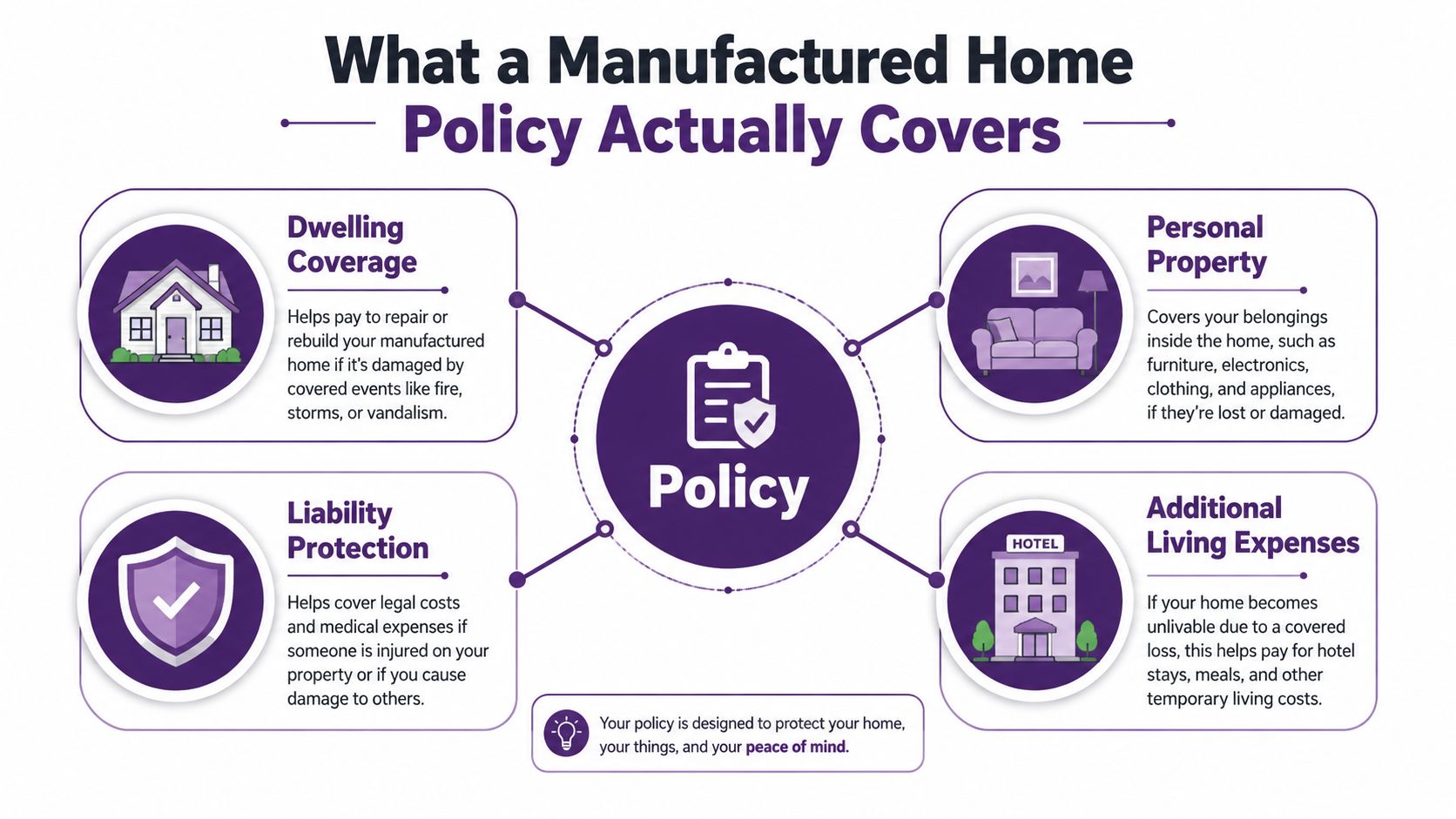
A manufactured-home policy protects several parts of your financial life. Limits and exclusions vary by carrier, but the structure is easier to follow when you separate the home from everything around it.
Dwelling coverage protects the structure itself. That usually includes the walls, roof, floors, and built-in appliances, subject to covered causes of loss and exclusions. The dwelling limit is the maximum amount assigned to the home, and it often anchors other limits on the policy.
Other structures coverage applies to separate property such as a detached carport, shed, deck, or similar structure. Do not assume every addition is automatically covered at the value you expect. A screened room or attached porch may need specific treatment in the application or policy.
Personal property coverage protects belongings inside the home. Furniture, clothing, electronics, tools, and household items may fall within this section. Some valuables have special limits, so the declarations page matters.
Loss of use coverage helps pay covered extra living costs when a covered loss makes the home uninhabitable. It may apply to temporary housing and related expenses, subject to the policy limit and conditions.
Liability coverage can respond when you are legally responsible for covered injury or property damage. A guest injury or another accident connected with the property may create a claim.
Medical payments to others is a no-fault benefit for certain minor guest injuries. The guest usually does not need to prove legal responsibility, but the policy terms still control.
The policy form matters
Manufactured homes are often insured on specialized forms, sometimes called an MH form or an HO-7 equivalent, not the standard HO-3 form many site-built homeowners know. The form controls covered causes of loss, exclusions, settlement rules, and optional endorsements.
Your lender will usually want the policy to identify the lender as mortgagee. It may also require a specific dwelling limit, deductible, effective date, and proof that coverage is active before funding. Ask the agent to send the binder or declarations information directly to the closing contact before the deadline.
How Underwriting Decides Your Eligibility and Price
Underwriting is the insurer's review of the home and its risk. For manufactured homes, that review often turns on physical details a standard homeowners application may barely address.
The home's age is one major dividing line. HUD guidance says manufactured homes must have an affixed HUD seal on the outside of the home, as described in the HUD seal and label guidance. That seal helps verify the dwelling's identity, but the insurer may still need more information about condition, installation, and updates.
Wind exposure gets close attention. Carrier and state guidance may consider wind-zone compliance, anchoring, permanent installation, and the property's distance from coastal wind territories. In some coastal markets, wind coverage may be excluded, priced separately, or placed through a specialty wind program.
A tie-down system connects the home's frame or structure to anchors in the ground. If the insurer cannot verify that installation, the quote may change or the property may need an inspection before binding. Roof age, skirting condition, occupancy, and the difference between owned land and a leased lot can also affect the result.
| Underwriting factor | Impact on premium or eligibility |
|---|---|
| Home age | Older homes may have fewer available policy forms or settlement options. |
| HUD seal and home identity | Missing or unclear documentation can delay eligibility review. |
| Wind zone and coastal location | Higher exposure can lead to higher pricing, separate wind coverage, or a decline. |
| Tie-down and anchoring | Missing certification can trigger questions, inspection needs, or restricted terms. |
| Roof and exterior condition | Poor condition can affect acceptance and the insurer's view of severity risk. |
| Owned land or leased lot | The ownership setup changes the property details reviewed by the carrier. |
A manufactured-home underwriting guideline from the North Carolina Insurance Department's 2011 manufactured-home guidelines provides a useful example of age-based eligibility. It states that a home must be 8 years old or less for replacement cost, 15 years old or less for alternative replacement cost, and 20 years old or newer for another eligibility tier. Older homes may sometimes be considered after renovations.
Those rules belong to that guideline, not every insurer. Your actual quote controls.
If you're comparing homes in a community, the manufactured-home community resources can help keep the property details organized before an application is submitted.
Replacement Cost Versus Actual Cash Value Settlements
The settlement method can matter more than a small premium difference.
Replacement cost pays the cost to repair or replace covered damage with new materials of similar kind and quality, subject to the policy limit and conditions. It does not subtract depreciation from the covered replacement amount.
Actual cash value subtracts depreciation for age and wear. A roof, floor, cabinet, or appliance that has been used for years may receive a lower claim payment than the cost of buying a new equivalent.
The United Policyholders manufactured-home buying guidance explains that some policies may pay the full insured amount for a total loss while using actual cash value for partial losses. That distinction is easy to miss if you only look at the dwelling limit.
The dwelling limit is the maximum amount assigned to the structure. It can also influence personal-property limits when contents coverage is calculated as a percentage of the dwelling amount. If the dwelling limit is too low, more than the structure may be underinsured.
| Scenario | Replacement cost payout | Actual cash value payout |
|---|---|---|
| Total covered loss | The insured amount, subject to policy terms and the dwelling limit | The insured value after depreciation, subject to policy terms |
| Partial roof damage | Cost to repair with new materials, subject to the deductible and policy rules | Repair value reduced for age and wear |
| Damaged personal property | New replacement may apply if the contents coverage provides it | Depreciated value may apply |
| Detached structure loss | Repair or replacement may apply within its limit | Age and condition reduce the payment |
Do not rely on a simple example from another policy as a promise about your claim. Ask the agent which settlement method applies to the dwelling, roof, personal property, and other structures.
Coverage Gaps That Leave Owners Exposed
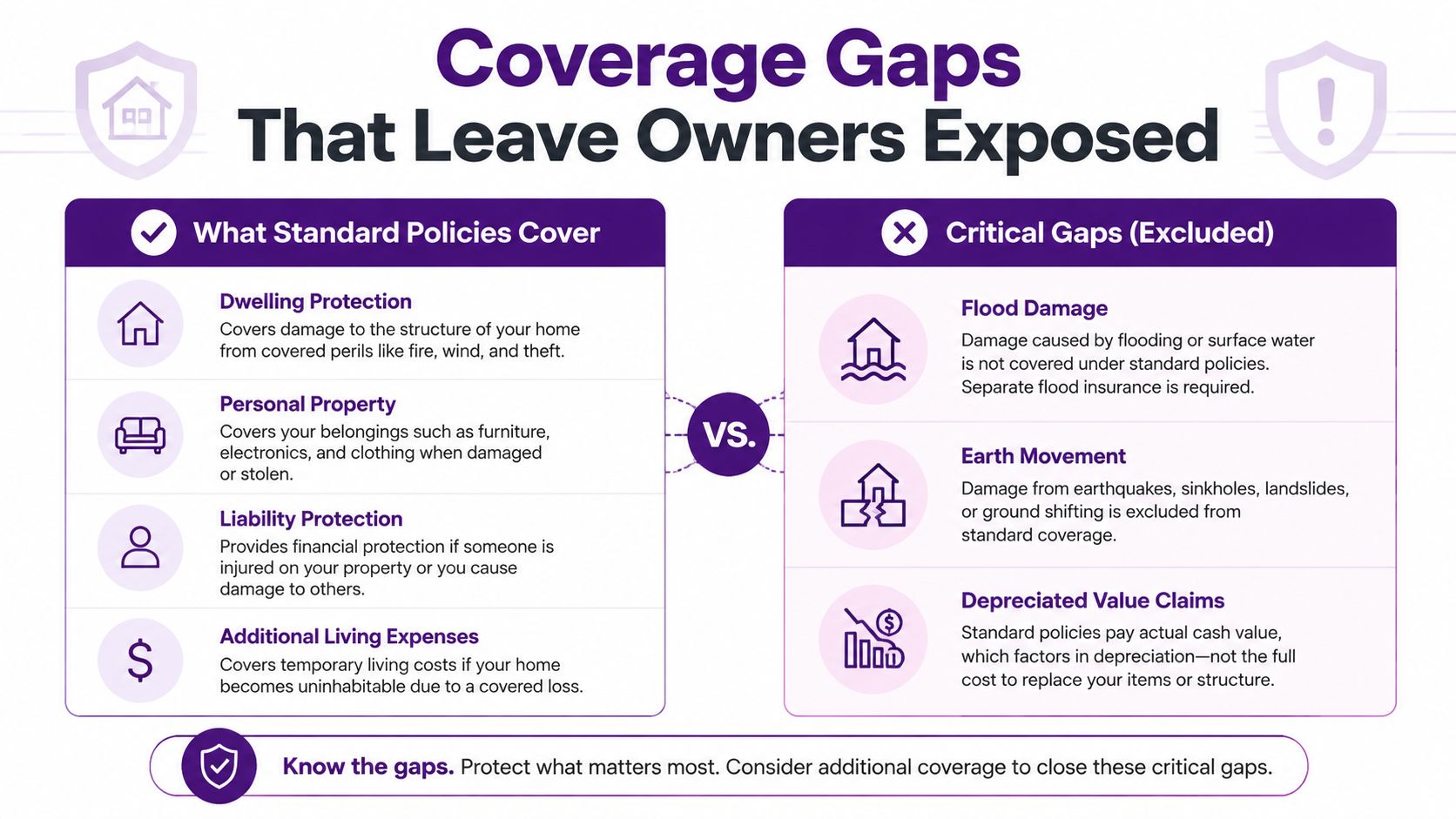
A buyer can have a policy, a lender-ready binder, and still face an uncovered loss. The problem often appears after a storm, when water, wind, poor maintenance, and multiple damage causes overlap. A standard manufactured-home policy does not cover every source of damage.
Flood deserves separate attention. The U.S. Treasury's 2025 insurance report says roughly twenty million American homes face significant financial flood risk while uninsured or underinsured. It also reports that nearly one-third of National Flood Insurance Program claims come from properties outside mapped high-risk areas, according to the Federal Insurance Office annual report. Standard manufactured-home insurance generally excludes flood, so the owner may need National Flood Insurance Program or private flood coverage.
A flood zone is only one warning sign. Buyers in Texas, Arizona, New Mexico, Utah, Nevada, and Alabama should ask about drainage, runoff, and prior water issues. Water can enter a home even when the address is outside an obvious high-risk area.
Deductibles can change the claim
A deductible is the amount the owner pays before insurance contributes to a covered loss. In Texas, the Department of Insurance says extended-coverage deductibles are commonly $100 or $250, though they may be set at 1% of the amount of insurance for each item. Optional larger dwelling deductibles include 1.5%, 2%, 2.5%, 3%, 4%, or 5%, as described in the Texas dwelling rules document.
Coastal Texas may involve a separate windstorm arrangement. The Texas Windstorm Insurance Association rating manual sets windstorm, hurricane, and hail deductibles at 1% inland of the Intracoastal Canal and 2% seaward of the canal, with a $250 minimum. The same home can produce a very different out-of-pocket claim cost depending on location.
Coverage can lapse during a sale, move, renewal, or cancellation notice. Consumer advocates report that many manufactured-home owners lack homeowners insurance. Administrative failures around non-renewal or cancellation notices can leave another group temporarily uninsured, even when the owner believes coverage continues.
Transport creates a separate exposure. Trip collision coverage protects the home while it is being moved, but it usually requires a specific endorsement or separate arrangement. Standard coverage may also restrict losses tied to settling, shifting foundations, poor maintenance, or improper anchoring. These exclusions can affect both a claim and the documents needed to complete a closing or renewal.
Getting Quotes and Keeping Coverage Continuous
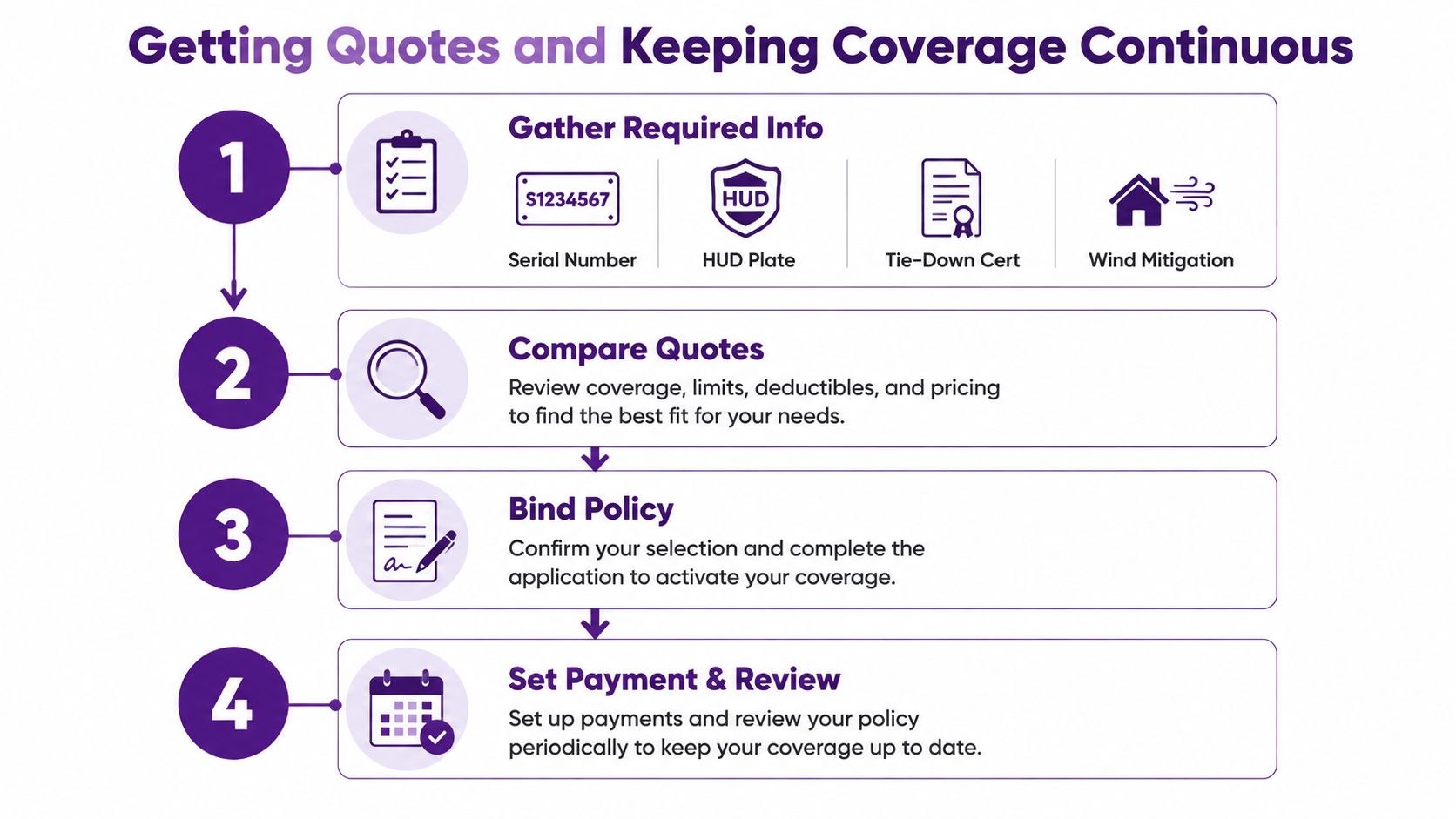
Maya should be the starting point Enter the home's details in Maya early so the licensed agent can use one complete set of property facts to shop quotes, spot underwriting issues, and avoid last-minute closing delays. Include the home age, installation type, wind exposure, owned land versus leased lot, and requested effective coverage date.
From there, Maya becomes the hub for the process. The agent can use the same property profile to compare carrier options, identify missing documents, and surface differences in eligibility before you choose a policy. That matters because carriers may treat the same home very differently. One may consider an older property with actual cash value, while another may decline it. One may ask for installation records. Another may require an inspection before binding.
Once quotes are available through Maya, compare more than premium. Review the dwelling limit, settlement method, wind or hurricane deductible, other-perils deductible, roof terms, personal-property limit, liability limit, and flood decision. After you choose a policy, make sure the binder or declarations information goes to the lender or closing contact on time.
Maya should stay part of the process after closing too. If the policy renews, the home is updated, or occupancy changes, refresh the property details so the next quote or renewal review starts with accurate information and continuous coverage is easier to maintain.
Maya compares manufactured-home insurance quotes so you can review premiums, deductibles, and coverage terms in one place. Gather your home details, request the comparison, and speak with a licensed agent who uses Maya before closing or renewal.