

You got the renewal notice while sitting on a leased lot, and the price jumped even though the home, roof, and address stayed the same. That feels arbitrary. It usually isn't.
Cheap insurance for manufactured homes comes from building a quote that fits your home accurately, then comparing that structure across carriers. The lowest headline premium can hide actual-cash-value settlement, a high wind deductible, or missing coverage for a carport or shed. Start with eligibility and coverage terms. Price comes after that.
Why Manufactured Home Insurance Costs More Than You Expect
Manufactured-home insurance uses a different risk lens than standard site-built homeowners coverage. The carrier isn't rating only the living area. It is also reviewing how the home was built, how it was installed, how it is anchored, and whether the policy form fits the property.
The home may be classified as a single-wide or double-wide. Its factory era matters too. Homes built before June 15, 1976 were not built under the federal manufactured-home standards that took effect on that date, so older units can face stricter eligibility rules or fewer available programs. HUD explains the construction standards and basic eligibility requirements for manufactured homes.
Wind exposure is another major factor. Tie-down and anchoring details can vary by location and wind zone. A carrier may ask how the home is secured, what foundation or support system it uses, and whether installation records are available. HUD installation rules also require installers, where available in the state, to maintain a surety bond or insurance covering installation damage to the home and its supports. The federal installation rule is described in the HUD regulation.
Practical rule: A quote built on incomplete construction or anchoring information may be cheap only because the carrier hasn't finished evaluating the risk.
Why specialty markets matter
Many standard homeowners carriers don't write manufactured homes. That leaves specialty programs with tighter underwriting and a smaller pool of eligible risks. Consumer Reports notes that manufactured-home insurance can cost twice as much as traditional homeowners coverage, even though more than 22 million people live in manufactured homes in the United States. Consumer Reports explains the coverage and pricing problem.
Replacement-cost valuation can also differ from what you expect. Replacement cost means the policy may pay to repair or replace covered damage without subtracting ordinary depreciation, subject to the policy terms. Actual cash value subtracts depreciation, so an older roof or older interior materials can produce a much smaller claim payment.
The price isn't random. It reflects the home's age, construction, installation, location, and settlement method. If you want a better quote, give the carrier better facts first. Maya's manufactured-home community resources can help you organize the property details needed for that conversation.
The Four Things That Actually Move Your Premium
Four pricing areas shape most manufactured-home quotes. You can change some of them. You can't change the ZIP code, but you can often change the deductible, coverage limits, documentation, and sometimes the home's risk features.
The home itself
The build year comes first. So do square footage, single-wide or double-wide classification, roof material, roof age, , continuous skirting or foundation setup, central heat, and the condition of electrical and plumbing systems. Review the 2011 manufactured-home underwriting guidelines.
You can't change the original build year of your home. However, you may be able to improve the roof, skirting, anchoring, or electrical system. Keep receipts and inspection records.
The location
Wind zone, flood exposure, distance to a fire hydrant or station, and local claims conditions affect the quote. Geographic risk is mostly fixed. Moving the home isn't a practical insurance strategy.
Flood deserves special attention. Standard manufactured-home policies commonly exclude flood damage, so a separate flood policy may be needed when the address or lender requires it. Don't assume wind coverage includes rising water.
The coverage structure
You have the most control. Compare replacement cost with actual cash value. Set the dwelling limit from a defensible valuation, then review detached structures, personal property, liability, and additional living expense limits.
Contents coverage can create extra paperwork. The 2022 Kentucky manufactured-home manual requires an itemized inventory when Coverage C exceeds 60% of Coverage A. Read the 2022 manufactured-home manual.
Your policy profile
Claims history matters. So can a credit-based insurance score where state law allows its use. The deductible and eligibility for auto, life, or umbrella bundling can shift the final price.
| Premium Driver | Example | Homeowner Can Change It? |
|---|---|---|
| Home | Build year, roof, anchoring | Partly |
| Location | Wind zone, flood exposure, fire access | Rarely |
| Coverage | Deductible, valuation, limits | Mostly |
| Policy profile | Claims, insurance score, bundling | Partly |
Raising Your Deductible to Lower the Bill
The deductible is the amount you pay before covered insurance benefits begin. A higher deductible can lower the annual bill, but it also moves more of the loss onto you.
A $500 deductible usually offers the easiest claim access, but it leaves you with the smallest initial payment requirement. A $1,000 deductible can reduce the premium, though the exact credit depends on the carrier, peril, and policy form. Some homeowners choose $2,500 or $5,000 deductibles when they have enough savings to handle a larger repair bill.
Don't choose the deductible by looking only at the monthly draft.
Use the actual quote. If a carrier's annual premium drops from $900 to $810 after the deductible rises from $500 to $1,000, the annual difference is about $90. That means you're accepting $500 more of potential out-of-pocket cost in exchange for about $90 in yearly savings. The calculation is simple, but the right choice depends on your cash reserve.
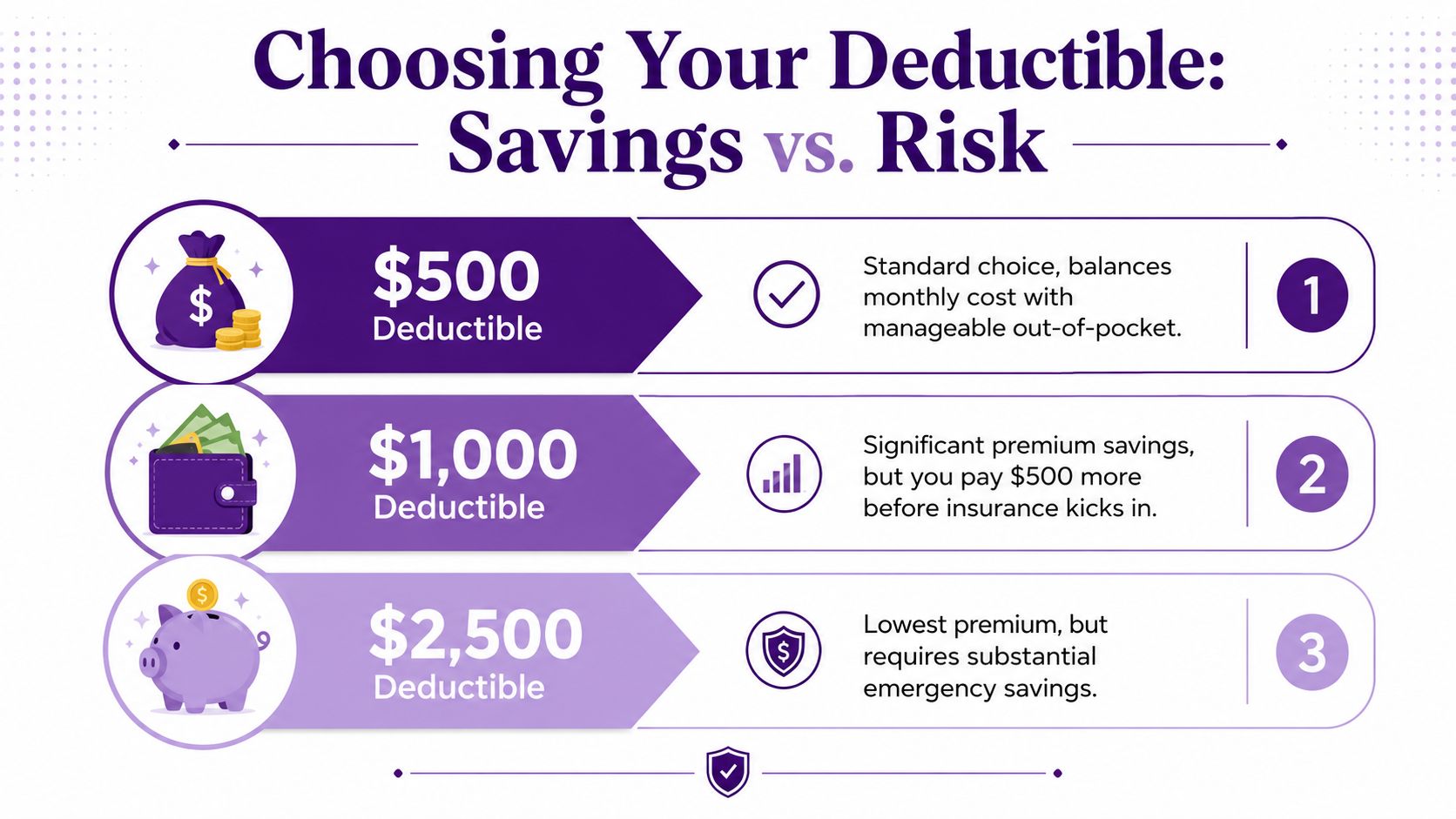
Match the deductible to your emergency savings
A deductible should be payable without using high-interest debt. If a $2,500 repair would force you to miss lot rent, delay utilities, or borrow money, that option isn't cheap for your household.
Wind and hurricane deductibles may work differently from the all-peril deductible. Read the declarations page and ask the licensed agent to explain how each deductible applies. Don't assume the same amount applies to every covered event.
A deductible also won't fix an ineligible home. If the carrier doesn't accept the roof, anchoring, age, or foundation details, choosing a higher deductible won't create coverage.
Pick the highest deductible you can fund comfortably. Then compare the full policy, not just the premium change.
Bundling Discounts and Multi-Carrier Shopping
Bundling means placing more than one policy with the same carrier. Auto insurance is the most common companion, though life or umbrella coverage may also qualify with some programs. The carrier may apply a multi-policy credit, but the credit doesn't automatically make the package cheaper.
A weak manufactured-home rate can erase the bundle savings. Compare the standalone home quote with the packaged quote, then compare both against a second carrier's home and auto combination.
| Approach | Typical Discount Range | Best Use Case | Limitation |
|---|---|---|---|
| Home only | Varies by carrier | You already have competitive auto coverage | No multi-policy credit |
| Home and auto | 5% to 20% according to consumer pricing guidance | Both policies are reasonably priced | A high home base rate can erase the credit |
| Home and umbrella | Varies by carrier | You need added liability protection | Umbrella eligibility can narrow |
| Existing carrier loyalty credit | Varies by carrier | You want fewer policy changes | Loyalty may not offset a rising base rate |
The 5% to 20% bundle range is a general range cited by the 2026 manufactured-home cost guide, not a promise from any carrier. The 2026 cost guide discusses bundle savings and manufactured-home pricing factors.
Eligibility Fixes That Improve Your Quote
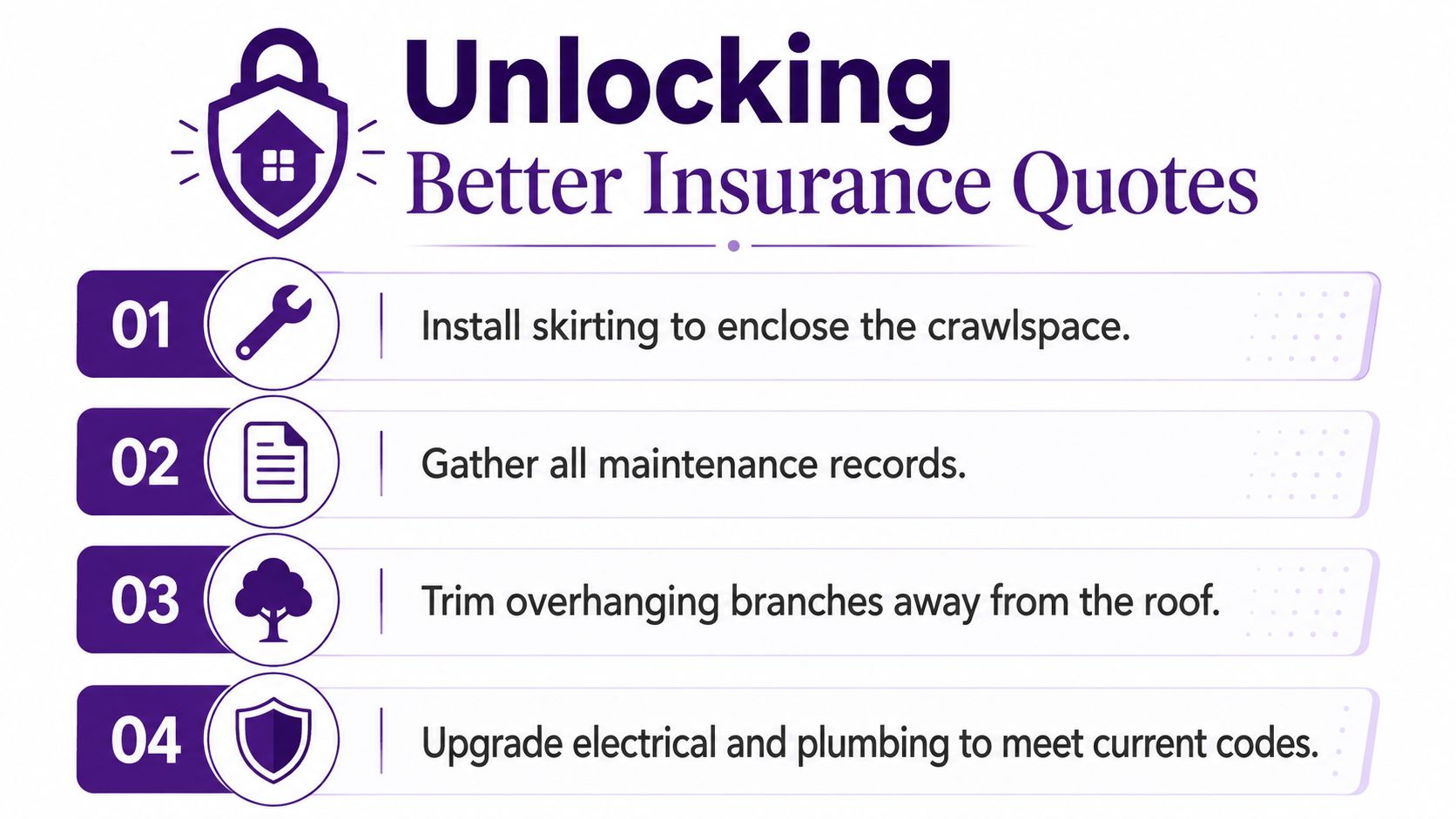
A cheaper policy starts with an insurable home, not a request for a lower price. Finish the work that affects eligibility, gather proof, then ask for a new quote using the updated property file.
Check beneath the home first. Missing or incomplete skirting can expose the crawlspace and raise underwriting concerns. The 2011 underwriting guide cited earlier calls for full or continuous skirting or an appropriate foundation setup. Anchoring also matters. Have a qualified installer or inspector verify the system, then keep the report and photographs.
Review the roof before you shop. Give the carrier its material, age, repair history, and replacement records. Trim branches away from the roof and replace damaged sections. Repairs may not produce a direct credit, but accurate records can move the home into a program willing to quote it.
Inside, test smoke and carbon monoxide detectors. Update electrical or plumbing systems when older components create code or fire concerns. Keep permits, invoices, inspection notes, and dated photographs together.
Send proof with the application
Carriers price documented risk, not planned improvements. A future roof replacement will not change the current quote. A completed repair supported by records can change the underwriting decision.
Keep one property file: Put the serial number, installation details, receipts, inspection reports, and photographs in one folder before you start shopping.
No repair guarantees a lower premium. A carrier may still reject an older home or a high-risk location. Complete documentation gives the underwriter facts about the actual home instead of a blank field or an assumption. That makes eligibility, deductible selection, and the final quote easier to compare.
Your Next Step: Shopping Multiple Carriers the Smart Way
The easiest way to shop correctly is to prepare your information once, then use Maya to keep the quote structure consistent across carriers.
Start by gathering the home serial number, year, make, dimensions, skirting type, foundation details, roof material, claims history, current declarations page, and requested coverage limits. Include detached structures such as a shed, carport, deck, or screen room. If a structure is left out, the cheapest quote may simply be missing coverage you need.
Maya helps by collecting those details through one application and sending the same property file to participating carriers in parallel. That matters because side by side shopping only works when each quote uses the same facts, the same dwelling limit, the same personal property limit, the same liability limit, the same deductible, and the same endorsements.
Instead of jumping between separate applications and trying to remember which carrier quoted what, you can review the results in one place. This makes it easier to spot when one quote is lower because of a higher wind deductible, actual-cash-value settlement, or weaker detached-structure coverage.
Compare the policy, not the headline
Maya is most useful when you treat it as a comparison tool, not just a way to find the smallest premium. Actual cash value may make an older home look cheaper because depreciation reduces a claim payment. Replacement cost may cost more but offer a different settlement result. Review exclusions for flood, earth movement, wear and tear, maintenance, mold, and pest damage.
For each quote, take note of the:
Annual premium
Deductible by peril
Valuation method
Liability limit
Personal property limit
Detached-structure coverage
Additional endorsements
Carrier conditions before binding
Maya can retrieve manufactured-home quotes through one application, send the information to participating carriers in parallel, and display premiums, deductibles, and coverage terms side by side. Availability is currently listed for Arizona, New Mexico, Utah, Texas, Alabama, and Nevada. See Maya's information for independent agents.
The right low-cost choice is the quote with the lowest total annual cost for the coverage you need. A smaller number with weaker settlement terms is not a savings plan.
Common Questions
Does owning the land change the policy?
It can. A home on a leased lot may need coverage that reflects the community arrangement, while a home on owned land may also involve land-based property, lender, or title requirements.
What if the home is older than the carrier allows?
Ask about other specialty programs, renovation requirements, and actual-cash-value terms. Older units, especially those built before 1976, may face harsher terms or ineligibility. Don't hide the age. An inaccurate application can create problems later.
Is this the same as RV insurance?
No. An RV or travel-trailer policy is designed for a vehicle or recreational use. A manufactured-home policy is designed for a home installed at a location, with different questions about dwelling, site structures, contents, and liability.
Can a lender require higher coverage?
Yes. A mortgage lender can require specific dwelling limits, deductibles, valuation terms, and proof of coverage. Your preferred low premium can't override the loan agreement.
Maya returns quotes, does not bind coverage, and does not give coverage advice. The licensed agent owns the placement. You can review more answers in the Maya frequently asked questions, but the lowest number still isn't the best policy if it removes replacement cost, liability, or detached-structure coverage.
Maya lets you submit manufactured-home information once and compare available carrier quotes side by side, including premiums, deductibles, and coverage terms. Visit Maya, then take the results to a licensed agent who can answer coverage questions and place the policy that fits your home.