
The average cost of a manufactured home in 2025 was $115,557 for new homes overall, but that number becomes much more useful once you break it down by home type. Single-section homes averaged $95,074, while multi-section homes averaged $156,170.
For many buyers, that price gap is exactly why manufactured homes stand out. They offer a more accessible path to homeownership, more flexibility across budgets, and a lower starting cost than many site-built alternatives.
The 2026 Headline Price for a Manufactured Home
An average can blur the full picture, but it still gives buyers a strong place to start. The U.S. Census Bureau's Manufactured Housing Survey, which Census says is sponsored by HUD, tracks shipments, prices, and home characteristics for new manufactured housing, so it provides a better benchmark than a listing site with mixed inventory. In 2021, the average manufactured home price was $108,100, while a comparable site-built home averaged $365,900 excluding land, according to the Census-backed benchmark. That left a gap of more than $257,000 (Census Manufactured Housing Survey).
That price gap helps explain why manufactured homes remain such an appealing option. Buyers get a real home at a much lower entry price before land, delivery, and setup are added. Pew reported that manufactured homes averaged about $72 per square foot, while site-built homes averaged about $144 per square foot in 2021, so the per-square-foot cost was roughly half.
Why the headline number changes by home type
The average cost of a manufactured home shifts with section count. The 2025 figures show single-section homes at $95,074, while multi-section homes reached $156,170. That difference reflects size, transport, and assembly work at the site.
Practical rule: if someone gives you one price for all manufactured homes, ask what type they mean.
For a current monthly reference point, FRED's single-section series shows $90,700 in March 2026 for single-section homes. That helps show why a single-wide can sit well below the all-home average in recent readings (FRED SPSNSAUS).
| Home Type | Average Price (2025) | Difference vs. All-Home Average |
|---|---|---|
| All new manufactured homes | $115,557 | Base figure |
| Single-section homes | $95,074 | -$20,483 |
| Multi-section homes | $156,170 | +$40,613 |
Single-Wide, Double-Wide, and Modular Compared
A single-wide usually costs less because it has fewer sections to transport and set. That makes it one of the most practical ownership options for buyers who want to control costs without giving up the benefits of owning a home. A double-wide costs more because you are paying for more square footage, more assembly work, and a larger finished footprint at the site. For many households, that extra cost still compares favorably with a site-built home of similar size. Modular homes can overlap manufactured-home pricing, but they follow a different code path, so they often sit in a separate comparison lane.
The Manufactured Housing Institute lists an average manufactured-home cost of $123,300, with single-section homes averaging $85,200, multi-section homes averaging $152,000, and an average cost per square foot of $84 (Manufactured Housing Institute). Pew's comparison report gives another clear benchmark, with single-section homes at $67 per square foot and double-section homes at $72 per square foot in 2021 (Pew comparison report).
How section count drives price
Section count changes more than the sticker price. More sections mean more hauling, more connection work, and more site labor, so the total project cost can rise even before you add land or utility hookups. Even so, many buyers still find that a larger manufactured home delivers strong value because it can provide much more living space at a lower total cost than many traditional builds.
Modular homes need a separate comparison because their pricing is shaped by local building-code requirements, delivery distance, and finish level. Their delivered cost can overlap with manufactured housing, but the compliance and installation steps are not the same, which matters when you compare quotes. If you are comparing community options, a community pricing page can help sort the housing type before you look at numbers.
| Home Type | Typical Size (sq ft) | Average Price Range | Price per Sq Ft |
|---|---|---|---|
| Single-wide manufactured home | Smaller footprint | Lower five figures to low six figures | Lower end of the manufactured-home range |
| Double-wide manufactured home | Larger footprint | Mid six figures in many markets | Mid-range per square foot |
| Modular home | Varies by plan | Often overlaps manufactured pricing | Market-dependent, code-dependent |
A home that looks cheaper on paper can still cost more to place if it needs a heavier setup, a longer haul, or a larger site footprint.
How Size and Age Move the Number
Square footage matters, but not in a straight line. Smaller homes usually carry a higher price per square foot because the fixed costs, delivery, setup, and basic compliance, get spread across less space. Larger homes can look expensive in total dollars while still landing at a more moderate per-square-foot rate.
Age matters too. Older homes often sell for less because lenders, insurers, and buyers all price in wear, code era, and upgrade needs. A home built for a different era can still be a practical purchase, but its price usually reflects what still needs work.
What buyers usually compare
A useful way to think about it is to separate entry-level resale, mid-age resale, and new construction. Older homes can look affordable until repairs show up. Newer homes cost more up front, but they usually come with more predictable condition and fewer immediate projects. That predictability is one reason many buyers see manufactured homes as a smart choice, especially when they want modern features at a price point that still feels reachable.
| Build Era | Typical Size | Example Price Point | Price per Sq Ft |
|---|---|---|---|
| Pre-1976 mobile home | Varies widely | Often below newer-home pricing | Highly variable |
| 1990s to 2000s manufactured home | Mid-size | Mid-range resale pricing | Moderate |
| New HUD-code manufactured home | Current plans | Higher sticker price | More consistent |
A simple comparison helps. A 1995 14x70 home at $45,000 and a new 16x80 double-section home at $165,000 are not competing in the same lane. They may both be manufactured homes, but they're not the same product, not the same setup burden, and not the same financing story.
Practical rule: compare price, age, and setup needs together, not one at a time.
Where the Official Numbers Come From
The most serious pricing conversations start with the Manufactured Housing Survey. Census publishes it, HUD sponsors it, and it tracks new manufactured-home shipments and prices at shipment. That makes it the cleanest public benchmark for what the home itself costs before land, delivery, and site work.
A second lens is the price index mirrored through Federal Reserve data. That series helps show broader movement in manufactured-home pricing over time, which is useful when buyers want to know whether the market is firming or softening. Neither source is the same as a dealer quote, though. Dealer inventory, resale listings, and lender data all tell a different story because they include different home ages, different locations, and different condition levels.
Why the same month can produce different numbers
A shipment-based survey and a resale listing site won't match. One is measuring new homes at shipment, the other is measuring what appears in the market. That's why you can see one source showing a single-wide average around the mid-$80,000s while resale channels sit higher or lower depending on inventory mix.
The buyer mistake is treating one number as the whole market. It isn't. If you're checking pricing, compare the shipment-based view with the resale view, then look at your own land, installation, and financing setup before you decide anything.
| Data Source | What It Measures | Single-Wide Average | Multi-Section Average | Limitation |
|---|---|---|---|---|
| Manufactured Housing Survey | New homes at shipment | Shipment-based average | Shipment-based average | Doesn't include site costs |
| Resale aggregator | Listings on the market | Listing-based average | Listing-based average | Mix of ages and conditions |
What the Home Itself Does Not Include
The average cost of a manufactured home is not the number to use if you're trying to budget your full move-in cost. The home itself is only one layer. Land, site prep, foundation work, utilities, and delivery can add a lot to the project total.
That does not make manufactured homes a weaker option. In many cases, it makes them a better one for budget-conscious buyers, because even after those added costs, the full project can still compare favorably with many site-built alternatives. A buyer looking at a $115,557 home can still end up with a much larger project. Recent neutral coverage puts broader project estimates from roughly $100,000 to $300,000+ once land, site prep, foundation, and utilities are included (Triad Financial Services article). That range is wide because location changes everything.
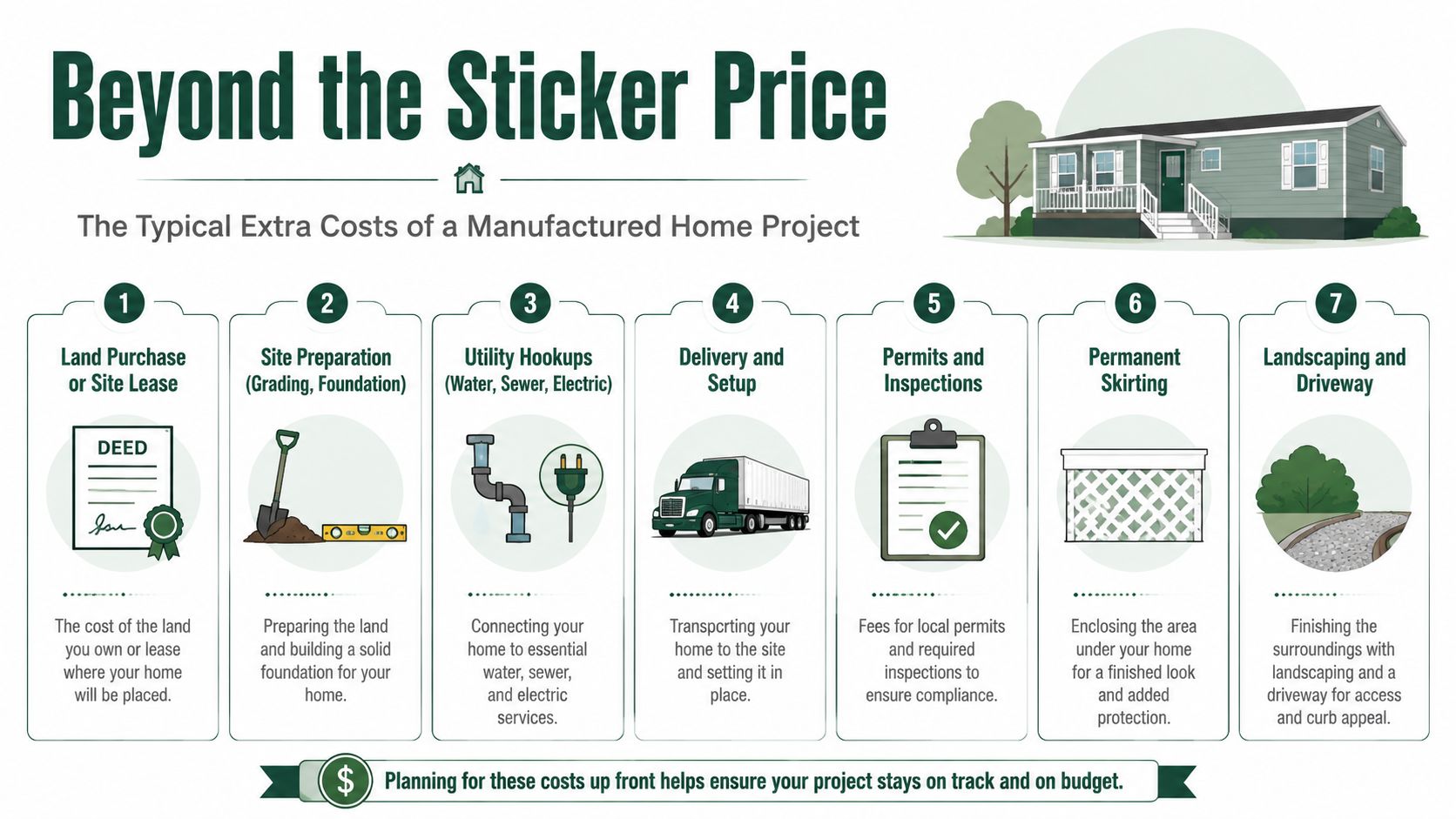
If you want the visual version, this infographic labels the usual setup layers clearly.
The line items buyers forget
The hidden cost categories are usually straightforward, just easy to underestimate.
Land or lot lease: this can be the biggest swing item.
Site preparation: grading, clearing, and foundation work add real labor.
Utility hookups: water, sewer, electric, and gas are separate jobs.
Delivery and setup: transport and on-site placement aren't free.
Permits and inspections: local offices still charge for approvals.
Skirting and exterior finish work: the home still needs a finished base.
Driveway and landscaping: access and drainage can't be ignored.
The big mistake is treating the home price as the project price. A buyer sees a factory quote and assumes the rest is a small add-on. It isn't.
Regional Price Differences Across the U.S.
Location changes the answer quickly. A manufactured home can have the same floor plan in two markets and still land at different delivered prices because shipping distance, climate rules, zoning, and local labor all affect the bill. The house may look identical on paper, but the total cost does not.
Regional averages also point in different directions. The South Central census division usually sits lower, while the Pacific division usually sits higher because of regulation, hauling distance, and market conditions. That reflects cost structure, not home quality.
Why the same floor plan costs different amounts
A buyer in a lower-cost region often starts with a lower home price before site work. A buyer in a higher-cost region may pay more for transport, permitting, and labor even when the model is the same. Weather rules and wind-zone requirements can also change the build itself, much like different job sites call for different tools.
State-level pricing matters more than a national average for planning. If your local market runs hot, the national figure can make your budget look better than it is. If your state is lower-cost, the national number can make the home seem less affordable than your local quote really is.
| Census Region | Single-Wide Average | Double-Wide Average | Key Driver of Premium or Discount |
|---|---|---|---|
| South Central | Lower than most regions | Lower than most regions | High production volume |
| Pacific | Higher than most regions | Higher than most regions | Zoning, shipping, labor |
| Other regions | Mixed | Mixed | Local rules and freight |
For buyers comparing a home in a park or land-lease setting, the community overview page helps separate the home's sticker price from placement costs. That split is the part many first-time buyers miss, and it is often where the budget changes most.
New Builds Compared to Resale Homes
A new manufactured home usually costs more than a resale unit. The resale average was $73,326, while the new-home average was $115,557. That gap is one reason used homes still make up a large share of the market.
The sticker price is only the first line on the budget. A resale home may also need roof work, skirting repair, leveling, appliance replacement, or cosmetic updates before it feels move-in ready. A new home often starts with modern HVAC, current insulation standards, and fewer immediate repairs, so the first months can be simpler to plan. For buyers who value efficiency, predictability, and updated features, that can make a new manufactured home a very strong choice.
What to compare before you choose
Financing can change the comparison. New homes often fit cleaner into standard dealer and chattel financing paths, while older resale homes can bring more inspection questions or renovation needs. Buyers who want a smoother closing process often prefer the predictability of new construction.
The dealership page helps you compare a new-home quote with a resale option in one place.
| Category | New Build | Resale Home |
|---|---|---|
| Average price | $115,557 | $73,326 |
| Repair risk | Lower at move-in | Higher at move-in |
| Financing profile | Usually cleaner | More variable |
| Immediate upkeep | Usually lighter | Depends on condition |
A lower resale price can still be the more expensive choice if several repairs are needed before you can move in.
Putting the Full Cost Picture Together
Here's the cleanest way to budget. Start with the home price, then add land, site prep, delivery, foundation, utilities, and finishing work. If you stop at the factory price, you'll miss the number that matters most, your move-in cost.
A realistic budget can move fast. A $115,557 home can become a far larger project once you add the site and utility work discussed above. That is why buyers get surprised, not because the numbers are hidden, but because they're spread across different vendors and different invoices. Even so, manufactured homes continue to make sense for many households because they can deliver modern living space at a lower cost of entry than many other homeownership paths.
One sample budgeting frame
Use your own numbers, but keep the categories in this order.
Home price: the factory or retail quote.
Land or lot lease: purchase or placement cost.
Site prep and foundation: grading, clearing, and support system.
Delivery and setup: transport, crane, and placement.
Utilities and final finish work: hookups, skirting, steps, and exterior work.
If you're looking at a remote site, delivery can climb quickly. If you're looking at a difficult lot, foundation work can move more than you expected. And if you're in a county with strict permits, fees show up before you've even set the home.
The fastest way to avoid a bad surprise is simple. Add every setup cost to the home price before you visit a dealership, then compare that total with a resale option in the same area. If you're shopping for quotes, the agent page is the place to compare how the same home and location can land differently across carriers.
Despite all of these planning considerations, manufactured homes remain a solid and accessible path to homeownership for many buyers. Compared with many standard site-built homes, they often offer a lower entry price, more flexibility across budgets, and a practical way to own a home without taking on the much higher costs that can come with traditional construction.
Maya returns quotes, does not bind coverage, and does not give coverage advice, the licensed agent owns the placement. If you want to compare what a manufactured-home quote looks like before you finalize your budget, visit Maya and see how the numbers line up side by side.