
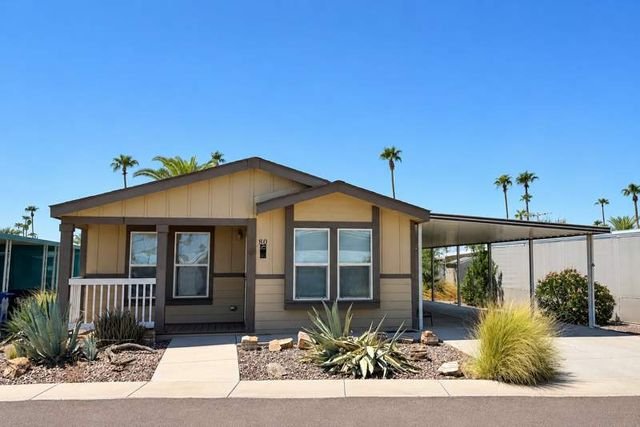
A monsoon storm has torn part of the roof from your 1985 single-wide in Phoenix. You call a standard homeowners insurer, only to learn that the company won't write the home. This is a common Arizona insurance problem, not a sign that you asked the wrong question.
Arizona manufactured home and mobile home insurance depends on details that generic homeowners guides often skip. The home's construction date, HUD records, tie-downs, roof, location, and policy form all affect what an insurer may offer. Arizona's market also includes older homes, park-model homes, leased-land communities, and rural homes exposed to wildfire or severe weather.
Why Arizona Manufactured Home Insurance Is Its Own Category
Arizona's manufactured-home market is large enough to support insurance programs built for these properties, rather than policies designed for site-built houses. That distinction matters because a manufactured home can sit on a permanent chassis, occupy a rented lot, or share a community with rules that affect the homeowner's responsibilities. Arizona manufactured-home market and insurance guidance
The address changes the underwriting questions. A home in a Mesa retirement community may be evaluated differently from a rural unit on private land in Pinal or Yavapai County. A single-wide built before federal standards may receive different terms from a newer HUD-code home. Attached Arizona rooms, park models used seasonally, tie-downs, roof condition, and skirting can also change what an insurer is willing to cover.
Arizona commonly uses the HO-7 policy form, which is written for manufactured homes. The form addresses features that a typical site-built-home policy may handle differently, including the chassis, attached structures, and a rented homesite. In a mobile-home park, the lease and park rules can also clarify which party is responsible for specific insurance obligations. Arizona mobile-home law
Arizona weather adds another layer. Monsoon wind, hail, dust storms, and wildfire influence questions about roof age, anchoring, foundation details, and nearby brush. The community setting matters too, so Arizona manufactured-home communities can help you identify whether your home is in a park, on leased land, or on a privately owned lot before requesting quotes.
Pre-HUD vs HUD-Code Homes and the HO-7 Form
The first question is the build date.
A structure built before June 15, 1976 is generally treated as a pre-HUD mobile home. It was built before federal manufactured-home construction standards took effect. A home built on or after that date is generally a HUD-code manufactured home, assuming its records and labels support that classification. Arizona manufactured-home insurance guidance
That difference affects the policy you may receive. Older homes are often written on actual cash value, meaning the insurer subtracts depreciation for age and condition. Newer HUD-code homes are more likely to qualify for replacement-cost coverage, which pays the covered cost to repair or replace the home up to the policy limit, without the same depreciation deduction.
The HO-7 is designed for manufactured homes. It isn't the same form commonly used for a site-built house, such as an HO-3. The insurer may add endorsements, or policy changes, for roof settlement, tie-downs, attached structures, or other manufactured-home features.
| Feature | Pre-HUD, built before 6/15/1976 | HUD-Code, built on or after 6/15/1976 |
|---|---|---|
| Construction standard | Built before federal manufactured-home standards | Built under the federal HUD Code |
| Documentation | Older records may require extra verification | HUD label and data plate usually identify the home |
| Settlement basis | Often actual cash value | More likely to qualify for replacement cost |
| Underwriting | Narrower carrier appetite is common | Broader options may exist if carrier rules are met |
| Key inspection details | Condition, age, anchoring, and repairs | Label, data plate, foundation, installation, and tie-downs |
Arizona treats HUD labels and data plates as important ownership records. The state housing department warns consumers not to lose them because these records help identify the home's status and compliance history. Arizona certificates and labels information
What an Arizona Manufactured Home Policy Usually Covers
A manufactured-home policy usually starts with dwelling coverage. This protects the home itself, subject to the policy limit and settlement method. The insurer may settle a claim at replacement cost or actual cash value, depending on the home and the policy.
Other structures coverage can apply to items such as an attached carport, shed, or Arizona room. Personal property coverage protects belongings inside the home, while liability coverage helps with covered claims if someone is injured on your property. Loss-of-use coverage can help pay for temporary living costs if covered damage makes the home unlivable.
The policy may also cover more than the exterior shell. An Arizona contract form from Commonwealth Casualty includes the manufactured home on the residence premises and permanently installed items such as floor coverings, appliances, dressers, and cabinets. It also addresses materials and supplies kept on or near the premises for construction, alteration, or repair. Arizona manufactured-home contract form
Ask your licensed agent about these items:
Matching siding: Helps address a partial loss when older siding is difficult to match.
Debris removal: Can help pay for removing damaged materials after a covered storm or fire.
Code upgrades: May help with required improvements, including anchoring or tie-down work required after a loss.
Scheduled property: Gives specific items, such as valuable tools or stored equipment, separately listed limits.
Some losses usually need separate treatment. Flood coverage generally requires a separate National Flood Insurance Program policy. Earth movement and wear are also commonly excluded or limited. Read the exclusions, not only the coverage page.
Arizona Perils That Shape Your Coverage
Arizona underwriting focuses heavily on wind, hail, dust, and wildfire. State insurance guidance identifies wildfire as the predominant homeowners risk in Arizona, while manufactured-home programs commonly address windstorm, hail, and fire. Those factors can tighten availability in high-exposure ZIP codes. Arizona manufactured-home insurer list and guidance
A named-peril policy covers only causes of loss listed in the form. An open-peril policy covers accidental physical loss unless the policy excludes it. Don't assume that “wind” means every wind-related event is handled the same way. Check the exact wording, the roof settlement method, and the deductible.
| Peril | Typical policy treatment | Common deductible treatment |
|---|---|---|
| Monsoon wind | Often listed under windstorm coverage | May have a separate wind deductible |
| Hail | Often listed, subject to roof terms | May share a wind and hail deductible |
| Wildfire and smoke | Fire coverage commonly applies | High-exposure areas may receive tighter terms |
| Dust storm | Damage depends on the covered cause and exclusions | Check damage to vents, seals, and equipment |
| Flood | Usually excluded from the home policy | Separate flood coverage may be needed |
| Earth movement | Commonly excluded or limited | Review endorsements and exclusions |
On an older roof, the insurer may settle wind or hail damage at actual cash value. That means age and condition reduce the payment. Tie-downs, skirting, foundation details, and defensible space can also affect the quote because they help the underwriter assess wind and fire exposure.
What Arizona Premiums Typically Look Like
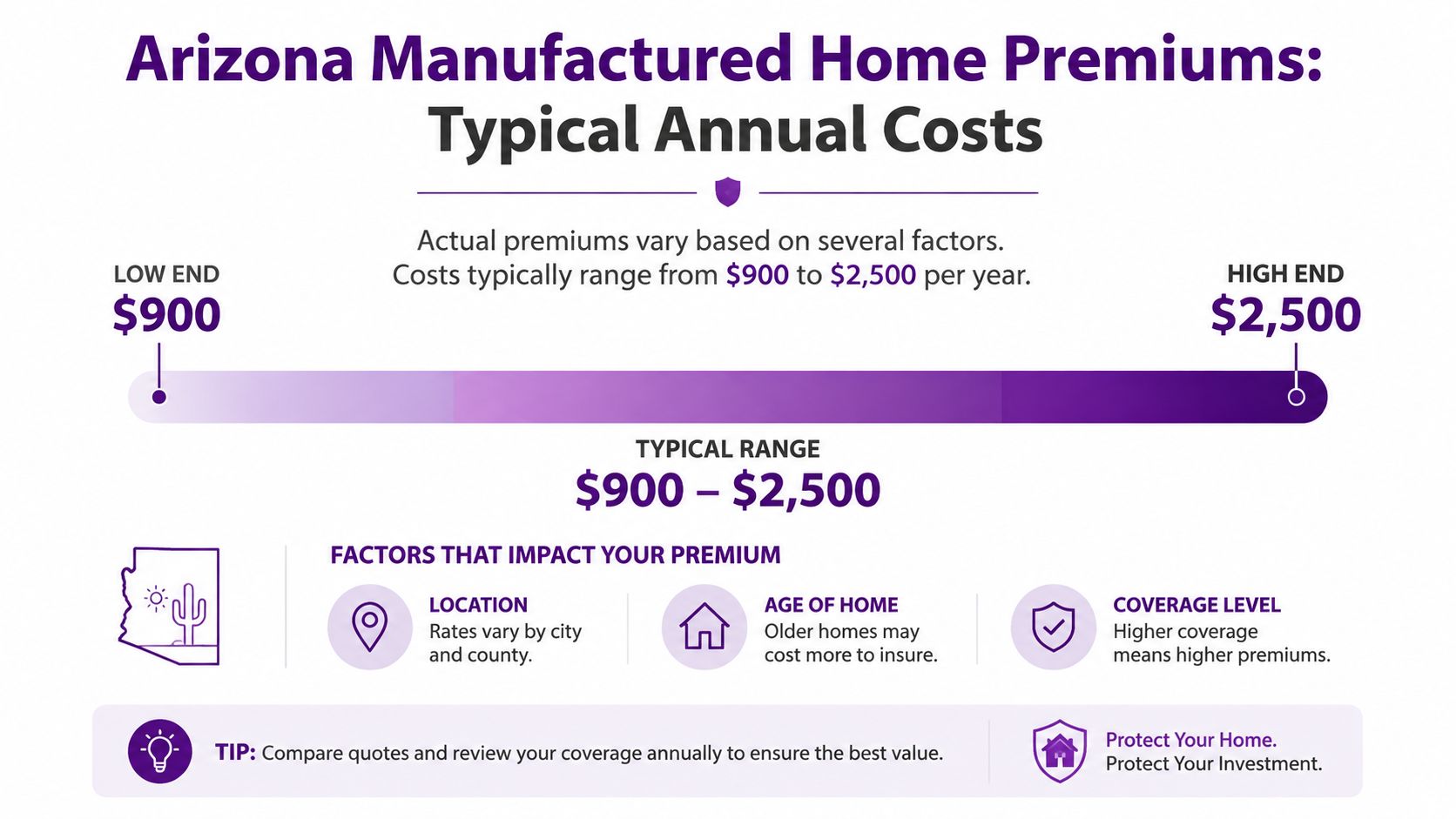
Arizona manufactured-home premiums vary widely. Industry commentary places typical premiums in a broad range of about $300 to $1,000 per year, while coverage, age, location, and underwriting conditions can produce a much higher quote for some homes. Arizona manufactured-home premium guidance
Treat any range as a starting point, not a promise. A pre-HUD home may be harder to place than a newer HUD-code home. A roof with little remaining life can change the settlement terms. A home in a leased-land park may be rated differently from a home on privately owned land.
Location matters. Wildfire exposure, monsoon wind, local construction costs, and the availability of repair contractors can all affect the price. The carrier may also review claims history, occupancy, home condition, tie-downs, skirting, and the type of foundation or installation.
Practical rule: Compare the deductible and settlement basis before comparing the premium.
A lower price may come with actual-cash-value roof coverage, a higher wind deductible, or narrower personal-property limits. Ask the agent to compare the dwelling limit, liability limit, wind and hail treatment, and loss-of-use coverage on the same page.
Let's get some quotes now for your home
The easiest next step is to fill out the Maya form with the basic details about your home. The more complete your information is, the easier it is to match your property with carriers that write Arizona manufactured and mobile homes.
Be ready to provide details such as:
The home's construction year.
Roof type and roof age.
The home's location, occupancy, and whether it sits on owned land or in a leased-land community.
You may also be asked about attached structures, prior claims, updates, and overall condition. These details help avoid inaccurate quotes and make it easier to compare coverage, deductibles, etc.
Once you submit your information, Maya will retrieve quotes from multiple carriers through one application for you. If you want help reviewing your options, you can also choose to be referred to a licensed broker who can walk you through the quotes, explain the differences, and help you bind the policy that fits your home.
Visit Maya to start your quote request and compare Arizona manufactured-home insurance options with one form.